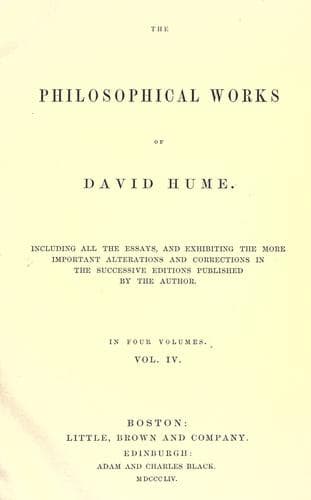
Philosophical Works, v. 1 (of 4): Including All the Essays, and Exhibiting the More Important Alterations and Corrections in the Successive Editions Published by the AuthorHume, David
PhilosophyPhilosophy
Philosophical Works, v. 1 (of 4): Including All the Essays, and Exhibiting the More Important Alterations and Corrections in the Successive Editions Published by the Author
Hume, David
Knowledge, Theory of; Philosophy, English -- 18th century
But 'tis evident, in the first place, that the repetition of like
objects in like relations of succession and contiguity, _discovers_
nothing new in any one of them; since we can draw no inference from
it, nor make it a subject either of our demonstrative or probable
reasonings; as has been already proved.[16] Nay, suppose we could draw
an inference, 'twould be of no consequence in the present case; since
no kind of reasoning can give rise to a new idea, such as this of power
is; but wherever we reason, we must antecedently be possessed of clear
ideas, which may be the objects of our reasoning. The conception always
precedes the understanding; and where the one is obscure, the other is
uncertain; where the one fails, the other must fail also.
Secondly, 'tis certain that this repetition of similar objects in
similar situations, _produces_ nothing new either in these objects, or
in any external body. For 'twill readily be allowed, that the several
instances we have of the conjunction of resembling causes and effects,
are in themselves entirely independent, and that the communication of
motion, which I see result at present from the shock of two billiard
balls, is totally distinct from that which I saw result from such an
impulse a twelvemonth ago. These impulses have no influence on each
other. They are entirely divided by time and place; and the one might
have existed and communicated motion, though the other never had been
in being.
There is, then, nothing new either discovered or produced in any
objects by their constant conjunction, and by the uninterrupted
resemblance of their relations of succession and contiguity. But 'tis
from this resemblance, that the ideas of necessity, of power, and of
efficacy, are derived. These ideas therefore represent not any thing,
that does or can belong to the objects, which are constantly conjoined.
This is an argument, which, in every view we can examine it, will be
found perfectly unanswerable. Similar instances are still the first
source of our idea of power or necessity; at the same time that they
have no influence by their similarity either on each other, or on any
external object. We must therefore turn ourselves to some other quarter
to seek the origin of that idea.
Public-domain text, read in full here on John Shaqi.
Reviews
Reviews
No reviews yet
Be the first to share your thoughts on this work.
Elsewhere in the archive
Join the Discussion
Join the discussion
Sign in to leave a comment or review.
Sign InorCreate an account