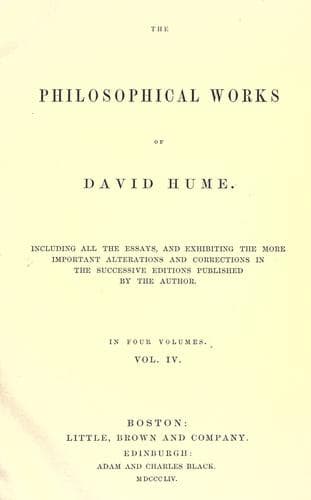
Philosophical Works, v. 1 (of 4): Including All the Essays, and Exhibiting the More Important Alterations and Corrections in the Successive Editions Published by the AuthorHume, David
PhilosophyPhilosophy
Philosophical Works, v. 1 (of 4): Including All the Essays, and Exhibiting the More Important Alterations and Corrections in the Successive Editions Published by the Author
Hume, David
Knowledge, Theory of; Philosophy, English -- 18th century
'Tis evident, that all the sciences have a relation, greater or less,
to human nature; and that, however wide any of them may seem to run
from it, they still return back by one passage or another; Even
_Mathematics_, _Natural Philosophy_, and _Natural Religion_, are in
some measure dependant on the science of MAN; since they lie under the
cognizance of men, and are judged of by their powers and faculties.
'Tis impossible to tell what changes and improvements we; might make in
these sciences were we thoroughly acquainted with the extent and force
of human understanding, and could explain the nature of the ideas we
employ, and of the operations we perform in our reasonings. And these
improvements are the more to be hoped for in natural religion, as it
is not content with instructing us in the nature of superior powers,
but carries its views farther, to their disposition towards us, and our
duties towards them; and consequently, we ourselves are not only the
beings that reason, but also one of the objects concerning which we
reason.
If, therefore, the sciences of mathematics, natural philosophy, and
natural religion, have such a dependence on the knowledge of man, what
may be expected in the other sciences, whose connexion with human
nature is more close and intimate? The sole end of logic is to explain
the principles and operations of our reasoning faculty, and the nature
of our ideas; morals and criticism regard our tastes and sentiments;
and politics consider men as united in society, and dependent on each
other. In these four sciences of _Logic_, _Morals_, _Criticism_, and
_Politics_, is comprehended almost every thing which it can any way
import us to be acquainted with, or which can tend either to the
improvement or ornament of the human mind.
Here then is the only expedient, from which we can hope for success in
our philosophical researches, to leave the tedious lingering method,
which we have hitherto followed, and, instead of taking now and then a
castle or village on the frontier, to march up directly to the capital
or centre of these sciences, to human nature itself; which being once
masters of, we may every where else hope for an easy victory. From this
station we may extend our conquests over all those sciences, which more
intimately concern human life, and may afterwards proceed at leisure,
to discover more fully those which are the objects of pure curiosity.
There is no question of importance, whose decision is not comprised
in the science of man; and there is none, which can be decided with
any certainty, before we become acquainted with that science. In
pretending, therefore, to explain the principles of human nature, we in
effect propose a complete system of the sciences, built on a foundation
almost entirely new, and the only one upon which they can stand with
any security.
Public-domain text, read in full here on John Shaqi.
Reviews
Reviews
No reviews yet
Be the first to share your thoughts on this work.
Elsewhere in the archive
Join the Discussion
Join the discussion
Sign in to leave a comment or review.
Sign InorCreate an account