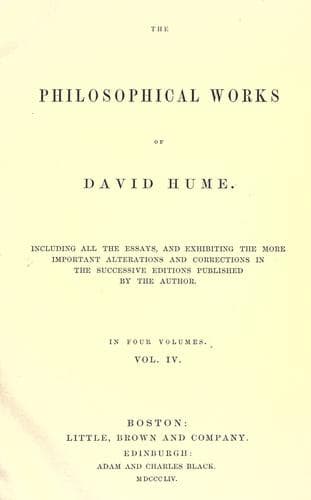
Philosophical Works, v. 1 (of 4): Including All the Essays, and Exhibiting the More Important Alterations and Corrections in the Successive Editions Published by the AuthorHume, David
PhilosophyPhilosophy
Philosophical Works, v. 1 (of 4): Including All the Essays, and Exhibiting the More Important Alterations and Corrections in the Successive Editions Published by the Author
Hume, David
Knowledge, Theory of; Philosophy, English -- 18th century
And, as the science of man is the only solid foundation for the other
sciences, so, the only solid foundation we can give to this science
itself must be laid on experience and observation. 'Tis no astonishing
reflection to consider, that the application of experimental philosophy
to moral subjects should come after that to natural, at the distance
of above a whole century; since we find in fact, that there was about
the same interval betwixt the origins of these sciences; and that,
reckoning from Thales to Socrates, the space of time is nearly equal to
that betwixt my Lord Bacon and some late philosophers[1] in England,
who have begun to put the science of man on a new footing, and have
engaged the attention, and excited the curiosity of the public. So true
it is, that however other nations may rival us in poetry, and excel us
in some other agreeable arts, the improvements in reason and philosophy
can only be owing to a land of toleration and of liberty.
Nor ought we to think, that this latter improvement in the science
of man will do less honour to our native country than the former in
natural philosophy, but ought rather to esteem it a greater glory,
upon account of the greater importance of that science, as well as
the necessity it lay under of such a reformation. For to me it seems
evident, that the essence of the mind being equally unknown to us with
that of external bodies, it must be equally impossible to form any
notion of its powers and qualities otherwise than from careful and
exact experiments, and the observation of those particular effects,
which result from its different circumstances and situations. And
though we must endeavour to render all our principles as universal as
possible, by tracing up our experiments to the utmost, and explaining
all effects from the simplest and fewest causes, 'tis still certain
we cannot go beyond experience; and any hypothesis, that pretends to
discover the ultimate original qualities of human nature, ought at
first to be rejected as presumptuous and chimerical.
Public-domain text, read in full here on John Shaqi.
Reviews
Reviews
No reviews yet
Be the first to share your thoughts on this work.
Elsewhere in the archive
Join the Discussion
Join the discussion
Sign in to leave a comment or review.
Sign InorCreate an account