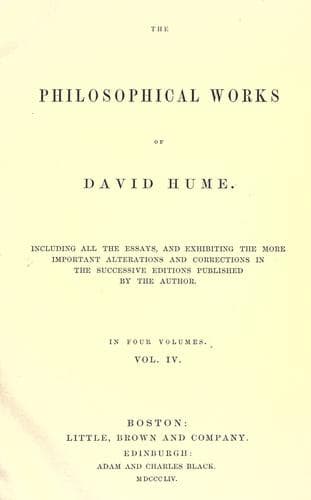
Philosophical Works, v. 1 (of 4): Including All the Essays, and Exhibiting the More Important Alterations and Corrections in the Successive Editions Published by the AuthorHume, David
PhilosophyPhilosophy
Philosophical Works, v. 1 (of 4): Including All the Essays, and Exhibiting the More Important Alterations and Corrections in the Successive Editions Published by the Author
Hume, David
Knowledge, Theory of; Philosophy, English -- 18th century
I do not think a philosopher, who would apply himself so earnestly to
the explaining the ultimate principles of the soul, would show himself
a great master in that very science of human nature, which he pretends
to explain, or very knowing in what is naturally satisfactory to the
mind of man. For nothing is more certain, than that despair has almost
the same effect upon us with enjoyment, and that we are no sooner
acquainted with the impossibility of satisfying any desire, than the
desire itself vanishes. When we see, that we have arrived at the utmost
extent of human reason, we sit down contented; though we be perfectly
satisfied in the main of our ignorance, and perceive that we can give
no reason for our most general and most refined principles, beside our
experience of their reality; which is the reason of the mere vulgar,
and what it required no study at first to have discovered for the most
particular and most extraordinary phenomenon. And as this impossibility
of making any farther progress is enough to satisfy the reader, so
the writer may derive a more delicate satisfaction from the free
confession of his ignorance, and from his prudence in avoiding that
error, into which so many have fallen, of imposing their conjectures
and hypotheses on the world for the most certain principles. When this
mutual contentment and satisfaction can be obtained betwixt the master
and scholar, I know not what more we can require of our philosophy.
But if this impossibility of explaining ultimate principles should be
esteemed a defect in the science of man, I will venture to affirm,
that it is a defect common to it with all the sciences, and all the
arts, in which we can employ ourselves, whether they be such as are
cultivated in the schools of the philosophers, or practised in the
shops of the meanest artisans. None of them can go beyond experience,
or establish any principles which are not founded on that authority.
Moral philosophy has, indeed, this peculiar disadvantage, which is
not found in natural, that in collecting its experiments, it cannot
make them purposely, with premeditation, and after such a manner as to
satisfy itself concerning every particular difficulty which may arise.
When I am at a loss to know the effects of one body upon another in
any situation, I need only put them in that situation, and observe
what results from it. But should I endeavour to clear up after the
same manner any doubt in moral philosophy, by placing myself in the
same case with that which I consider, 'tis evident this reflection and
premeditation would so disturb the operation of my natural principles,
as must render it impossible to form any just conclusion from the
phenomenon. We must, therefore, glean up our experiments in this
science from a cautious observation of human life, and take them as
they appear in the common course of the world, by men's behaviour in
company, in affairs, and in their pleasures. Where experiments of this
Public-domain text, read in full here on John Shaqi.
Reviews
Reviews
No reviews yet
Be the first to share your thoughts on this work.
Elsewhere in the archive
Join the Discussion
Join the discussion
Sign in to leave a comment or review.
Sign InorCreate an account