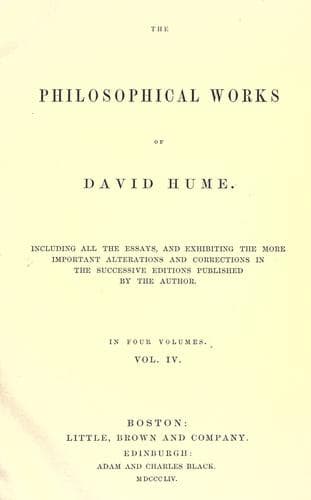
Philosophical Works, v. 1 (of 4): Including All the Essays, and Exhibiting the More Important Alterations and Corrections in the Successive Editions Published by the AuthorHume, David
PhilosophyPhilosophy
Philosophical Works, v. 1 (of 4): Including All the Essays, and Exhibiting the More Important Alterations and Corrections in the Successive Editions Published by the Author
Hume, David
Knowledge, Theory of; Philosophy, English -- 18th century
kind are judiciously collected and compared, we may hope to establish
on them a science which will not be inferior in certainty, and will be
much superior in utility, to any other of human comprehension.
[1] Mr Locke, my Lord Shaftsbury, Dr Mandeville, Mr Hutchinson, Dr
Butler, &c.
BOOK I.
OF THE UNDERSTANDING.
PART I.
OF IDEAS, THEIR ORIGIN, COMPOSITION, CONNEXION,
AND ABSTRACTION.
SECTION I.
OF THE ORIGIN OF OUR IDEAS.
All the perceptions of the human mind resolve themselves into two
distinct kinds, which I shall call _impressions_ and _ideas_. The
difference betwixt these consists in the degrees of force and
liveliness, with which they strike upon the mind, and make their way
into our thought or consciousness. Those perceptions which enter with
most force and violence, we may name _impressions_; and, under this
name, I comprehend all our sensations, passions, and emotions, as they
make their first appearance in the soul. By _ideas_, I mean the faint
images of these in thinking and reasoning; such as, for instance, are
all the perceptions excited by the present discourse, excepting only
those which arise from the sight and touch, and excepting the immediate
pleasure or uneasiness it may occasion. I believe it will not be very
necessary to employ many Words, in explaining this distinction. Every
one of himself will readily perceive the difference betwixt feeling
and thinking. The common degrees of these are easily distinguished;
though it is not impossible but, in particular instances, they may very
nearly approach to each other. Thus, in sleep, in a fever, in madness,
or in any very violent emotions of soul, our ideas may approach to
our impressions: as, on the other hand, it sometimes happens, that
our impressions are so faint and low, that we cannot distinguish them
from our ideas. But, notwithstanding this near resemblance in a few
instances, they are in general so very different, that no one can make
a scruple to rank them under distinct heads, and assign to each a
peculiar name to mark the difference.[1]
There is another division of our perceptions, which it will be
convenient to observe, and which extends itself both to our impressions
and ideas. This division is into _simple_ and _complex_. Simple
perceptions, or impressions and ideas, are such as admit of no
distinction nor separation. The complex are the contrary to these, and
may be distinguished into parts. Though a particular colour, taste and
smell, are qualities all united together in this apple, 'tis easy to
perceive they are not the same, but are at least distinguishable from
each other.
Public-domain text, read in full here on John Shaqi.
Reviews
Reviews
No reviews yet
Be the first to share your thoughts on this work.
Elsewhere in the archive
Join the Discussion
Join the discussion
Sign in to leave a comment or review.
Sign InorCreate an account