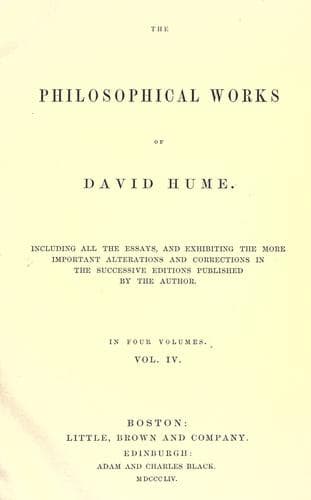
Philosophical Works, v. 1 (of 4): Including All the Essays, and Exhibiting the More Important Alterations and Corrections in the Successive Editions Published by the AuthorHume, David
PhilosophyPhilosophy
Philosophical Works, v. 1 (of 4): Including All the Essays, and Exhibiting the More Important Alterations and Corrections in the Successive Editions Published by the Author
Hume, David
Knowledge, Theory of; Philosophy, English -- 18th century
Having, by these divisions, given an order and arrangement to our
objects, we may now apply ourselves to consider, with the more
accuracy, their qualities and relations. The first circumstance that
strikes my eye, is the great resemblance betwixt our impressions and
ideas in every other particular, except their degree of force and
vivacity. The one seem to be, in a manner, the reflection of the other;
so that all the perceptions of the mind are double, and appear both as
impressions and ideas. When I shut my eyes, and think of my chamber,
the ideas I form are exact representations of the impressions I felt;
nor is there any circumstance of the one, which is not to be found in
the other. In running over my other perceptions, I find still the same
resemblance and representation. Ideas and impressions appear always to
correspond to each other. This circumstance seems to me remarkable, and
engages my attention for a moment.
Upon a more accurate survey I find I have been carried away too far
by the first appearance, and that I must make use of the distinction
of perceptions into _simple_ and _complex_, to limit this general
decision, _that all our ideas and impressions are resembling_. I
observe that many of our complex ideas never had impressions that
corresponded to them, and that many of our complex impressions never
are exactly copied in ideas. I can imagine to myself such a city as the
New Jerusalem, whose pavement is gold, and walls are rubies, though I
never saw any such. I have seen Paris; but shall I affirm I can form
such an idea of that city, as will perfectly represent all its streets
and houses in their real and just proportions?
I perceive, therefore, that though there is, in general, a great
resemblance betwixt our _complex_ impressions and ideas, yet the rule
is not universally true, that they are exact copies of each other. We
may next consider, how the case stands with our _simple_ perceptions.
After the most accurate examination of which I am capable, I venture to
affirm, that the rule here holds without any exception, and that every
simple idea has a simple impression, which resembles it, and every
simple impression a correspondent idea. That idea of red, which we form
in the dark, and that impression, which strikes our eyes in sunshine,
differ only in degree, not in nature. That the case is the same with
all our simple impressions and ideas, 'tis impossible to prove by a
particular enumeration of them. Every one may satisfy himself in this
point by running over as many as he pleases. But if any one should deny
this universal resemblance, I know no way of convincing him, but by
desiring him to show a simple impression that has not a correspondent
idea, or a simple idea that has not a correspondent impression. If he
does not answer this challenge, as 'tis certain he cannot, we may, from
his silence and our own observation, establish our conclusion.
Public-domain text, read in full here on John Shaqi.
Reviews
Reviews
No reviews yet
Be the first to share your thoughts on this work.
Elsewhere in the archive
Join the Discussion
Join the discussion
Sign in to leave a comment or review.
Sign InorCreate an account