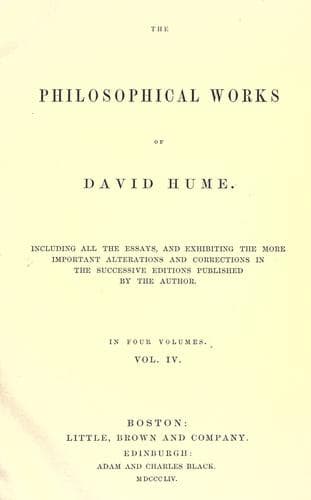
Philosophical Works, v. 1 (of 4): Including All the Essays, and Exhibiting the More Important Alterations and Corrections in the Successive Editions Published by the AuthorHume, David
PhilosophyPhilosophy
Philosophical Works, v. 1 (of 4): Including All the Essays, and Exhibiting the More Important Alterations and Corrections in the Successive Editions Published by the Author
Hume, David
Knowledge, Theory of; Philosophy, English -- 18th century
Thus we find, that all simple ideas and impressions resemble each
other; and, as the complex are formed from them, we may affirm
in general, that these two species of perception are exactly
correspondent. Having discovered this relation, which requires
no farther examination, I am curious to find some other of their
qualities. Let us consider, how they stand with regard to their
existence, and which of the impressions and ideas are causes, and which
effects.
The full examination of this question is the subject of the present
treatise; and, therefore, we shall here content ourselves with
establishing one general proposition, _That all our simple ideas in
their first appearance, are derived from simple impressions, which are
correspondent to them, and which they exactly represent_.
In seeking for phenomena to prove this proposition, I find only those
of two kinds; but, in each kind the phenomena are obvious, numerous,
and conclusive. I first make myself certain, by a new review, of what
I have already asserted, that every simple impression is attended
with a correspondent idea, and every simple idea with a correspondent
impression. From this constant conjunction of resembling perceptions
I immediately conclude, that there is a great connexion betwixt
our correspondent impressions and ideas, and that the existence of
the one has a considerable influence upon that of the other. Such
a constant conjunction, in such an infinite number of instances,
can never arise from chance; but clearly proves a dependence of the
impressions on the ideas, or of the ideas on the impressions. That I
may know on which side this dependence lies, I consider the order of
their _first appearance_; and find, by constant experience, that the
simple impressions always take the precedence of their correspondent
ideas, but never appear in the contrary order. To give a child an
idea of scarlet or orange, of sweet or bitter, I present the objects,
or, in other words, convey to him these impressions; but proceed not
so absurdly, as to endeavour to produce the impressions by exciting
the ideas. Our ideas, upon their appearance, produce not their
correspondent impressions, nor do we perceive any colour, or feel any
sensation merely upon thinking of them. On the other hand we find, that
any impression, either of the mind or body, is constantly followed
by an idea, which resembles it, and is only different in the degrees
of force and liveliness. The constant conjunction of our resembling
perceptions, is a convincing proof, that the one are the causes of
the other; and this priority of the impressions is an equal proof,
that our impressions are the causes of our ideas, not our ideas of our
impressions.
Public-domain text, read in full here on John Shaqi.
Reviews
Reviews
No reviews yet
Be the first to share your thoughts on this work.
Elsewhere in the archive
Join the Discussion
Join the discussion
Sign in to leave a comment or review.
Sign InorCreate an account