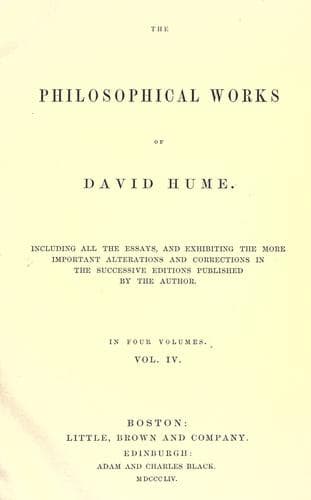
Philosophical Works, v. 1 (of 4): Including All the Essays, and Exhibiting the More Important Alterations and Corrections in the Successive Editions Published by the AuthorHume, David
PhilosophyPhilosophy
Philosophical Works, v. 1 (of 4): Including All the Essays, and Exhibiting the More Important Alterations and Corrections in the Successive Editions Published by the Author
Hume, David
Knowledge, Theory of; Philosophy, English -- 18th century
To confirm this, I consider another plain and convincing phenomenon;
which is, that wherever, by any accident, the faculties which give
rise to any impressions are obstructed in their operations, as when
one is born blind or deaf, not only the impressions are lost, but also
their correspondent ideas; so that there never appear in the mind the
least traces of either of them. Nor is this only true, where the organs
of sensation are entirely destroyed, but likewise where they have never
been put in action to produce a particular impression. We cannot form
to ourselves a just idea of the taste of a pine-apple, without having
actually tasted it.
There is, however, one contradictory phenomenon, which may prove,
that 'tis not absolutely impossible for ideas to go before their
correspondent impressions. I believe it will readily be allowed,
that the several distinct ideas of colours, which enter by the eyes,
or those of sounds, which are conveyed by the hearing, are really
different from each other, though, at the same time, resembling. Now,
if this be true of different colours, it must be no less so of the
different shades of the same colour, that each of them produces a
distinct idea, independent of the rest. For if this should be denied,
'tis possible, by the continual gradation of shades, to run a colour
insensibly into what is most remote from it; and, if you will not
allow any of the means to be different, you cannot, without absurdity,
deny the extremes to be the same. Suppose, therefore, a person to have
enjoyed his sight for thirty years, and to have become perfectly well
acquainted with colours of all kinds, excepting one particular shade of
blue, for instance, which it never has been his fortune to meet with.
Let all the different shades of that colour, except that single one,
be placed before him, descending gradually from the deepest to the
lightest; 'tis plain, that he will perceive a blank, where that shade
is wanting, and will be sensible that there is a greater distance in
that place, betwixt the contiguous colours, than in any other. Now I
ask, whether 'tis possible for him, from his own imagination, to supply
this deficiency, and raise up to himself the idea of that particular
shade, though it had never been conveyed to him by his senses? I
believe there are few but will be of opinion that he can; and this may
serve as a proof, that the simple ideas are not always derived from
the correspondent impressions; though the instance is so particular
and singular, that 'tis scarce worth our observing, and does not merit
that, for it alone, we should alter our general maxim.
Public-domain text, read in full here on John Shaqi.
Reviews
Reviews
No reviews yet
Be the first to share your thoughts on this work.
Elsewhere in the archive
Join the Discussion
Join the discussion
Sign in to leave a comment or review.
Sign InorCreate an account