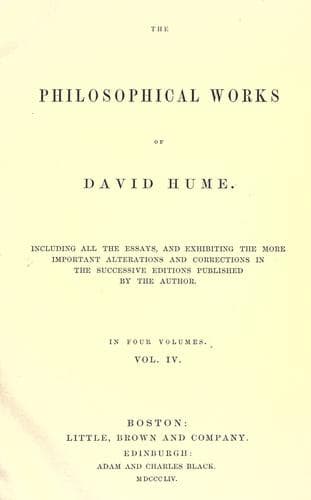
Philosophical Works, v. 1 (of 4): Including All the Essays, and Exhibiting the More Important Alterations and Corrections in the Successive Editions Published by the AuthorHume, David
PhilosophyPhilosophy
Philosophical Works, v. 1 (of 4): Including All the Essays, and Exhibiting the More Important Alterations and Corrections in the Successive Editions Published by the Author
Hume, David
Knowledge, Theory of; Philosophy, English -- 18th century
But, besides this exception, it may not be amiss to remark, on this
head, that the principle of the priority of impressions to ideas, must
be understood with another limitation, viz. that as our ideas are
images of our impressions, so we can form secondary ideas, which are
images of the primary, as appears from this very reasoning concerning
them. This is not, properly speaking, an exception to the rule so
much as an explanation of it. Ideas produce the images of themselves
in new ideas; but as the first ideas are supposed to be derived from
impressions, it still remains true, that all our simple ideas proceed,
either mediately or immediately, from their correspondent impressions.
This, then, is the first principle I establish in the science of human
nature; nor ought we to despise it because of the simplicity of its
appearance. For 'tis remarkable, that the present question concerning
the precedency of our impressions or ideas, is the same with what has
made so much noise in other terms, when it has been disputed whether
there be any _innate ideas_, or whether all ideas be derived from
sensation and reflection. We may observe, that in order to prove
the ideas of extension and colour not to be innate, philosophers do
nothing but show, that they are conveyed by our senses. To prove the
ideas of passion and desire not to be innate, they observe, that we
have a preceding experience of these emotions in ourselves. Now, if
we carefully examine these arguments, we shall find that they prove
nothing but that ideas are preceded by other more lively perceptions,
from which they are derived, and which they represent. I hope this
clear stating of the question will remove all disputes concerning it,
and will render this principle of more use in our reasonings, than it
seems hitherto to have been.
[1] I here make use of these terms, _impression_ and _idea_, in a sense
different from what is usual, and I hope this liberty will be allowed
me. Perhaps I rather restore the word idea to its original sense,
from which Mr Locke had perverted it, in making it stand for all our
perceptions. By the term of impression, I would not be understood to
express the manner in which our lively perceptions are produced in the
soul, but merely the perceptions themselves; for which there is no
particular name, either in the English or any other language that I
know of.
SECTION II.
DIVISION OF THE SUBJECT.
Public-domain text, read in full here on John Shaqi.
Reviews
Reviews
No reviews yet
Be the first to share your thoughts on this work.
Elsewhere in the archive
Join the Discussion
Join the discussion
Sign in to leave a comment or review.
Sign InorCreate an account