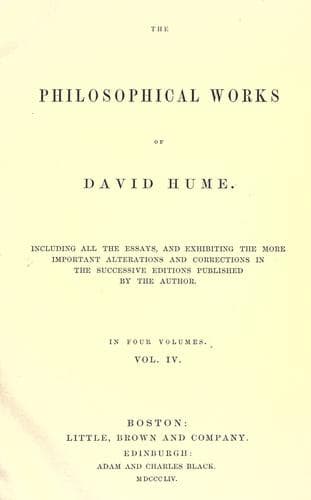
Philosophical Works, v. 1 (of 4): Including All the Essays, and Exhibiting the More Important Alterations and Corrections in the Successive Editions Published by the AuthorHume, David
PhilosophyPhilosophy
Philosophical Works, v. 1 (of 4): Including All the Essays, and Exhibiting the More Important Alterations and Corrections in the Successive Editions Published by the Author
Hume, David
Knowledge, Theory of; Philosophy, English -- 18th century
Since it appears, that our simple impressions are prior to their
correspondent ideas, and that the exceptions are very rare, method
seems to require we should examine our impressions before we consider
our ideas. Impressions may be divided into two kinds, those of
_sensation_, and those of _reflection_. The first kind arises in the
soul originally, from unknown causes. The second is derived, in a
great measure, from our ideas, and that in the following order. An
impression first strikes upon the senses, and makes us perceive heat
or cold, thirst or hunger, pleasure or pain, of some kind or other. Of
this impression there is a copy taken by the mind, which remains after
the impression ceases; and this we call an idea. This idea of pleasure
or pain, when it returns upon the soul, produces the new impressions
of desire and aversion, hope and fear, which may properly be called
impressions of reflection, because derived from it. These again are
copied by the memory and imagination, and become ideas; which, perhaps,
in their turn, give rise to other impressions and ideas: so that the
impressions of reflection are only antecedent to their correspondent
ideas, but posterior to those of sensation, and derived from them. The
examination of our sensations belongs more to anatomists and natural
philosophers than to moral; and, therefore, shall not at present be
entered upon. And, as the impressions of reflection, viz. passions,
desires, and emotions, which principally deserve our attention, arise
mostly from ideas, 'twill be necessary to reverse that method, which
at first sight seems most natural; and, in order to explain the nature
and principles of the human mind, give a particular account of ideas,
before we proceed to impressions. For this reason, I have here chosen
to begin with ideas.
SECTION III.
OF THE IDEAS OF THE MEMORY AND IMAGINATION.
Public-domain text, read in full here on John Shaqi.
Reviews
Reviews
No reviews yet
Be the first to share your thoughts on this work.
Elsewhere in the archive
Join the Discussion
Join the discussion
Sign in to leave a comment or review.
Sign InorCreate an account