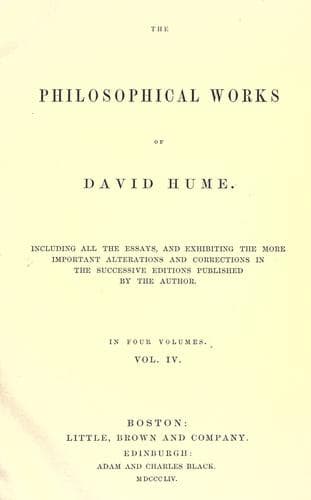
Philosophical Works, v. 1 (of 4): Including All the Essays, and Exhibiting the More Important Alterations and Corrections in the Successive Editions Published by the AuthorHume, David
PhilosophyPhilosophy
Philosophical Works, v. 1 (of 4): Including All the Essays, and Exhibiting the More Important Alterations and Corrections in the Successive Editions Published by the Author
Hume, David
Knowledge, Theory of; Philosophy, English -- 18th century
We find, by experience, that when any impression has been present with
the mind, it again makes its appearance there as an idea; and this it
may do after two different ways: either when, in its new appearance,
it retains a considerable degree of its first vivacity, and is somewhat
intermediate betwixt an impression and an idea; or when it entirely
loses that vivacity, and is a perfect idea. The faculty by which we
repeat our impressions in the first manner, is called the _memory_, and
the other the _imagination_. 'Tis evident, at first sight, that the
ideas of the memory are much more lively and strong than those of the
imagination, and that the former faculty paints its objects in more
distinct colours, than any which are employed by the latter. When we
remember any past event, the idea of it flows in upon the mind in a
forcible manner; whereas, in the imagination, the perception is faint
and languid, and cannot, without difficulty, be preserved by the mind
steady and uniform for any considerable time. Here, then, is a sensible
difference betwixt one species of ideas and another. But of this more
fully hereafter.[2]
There is another difference betwixt these two kinds of ideas, which is
no less evident, namely, that though neither the ideas of the memory
nor imagination, neither the lively nor faint ideas, can make their
appearance in the mind, unless their correspondent impressions have
gone before to prepare the way for them, yet the imagination is not
restrained to the same order and form with the original impressions;
while the memory is in a manner tied down in that respect, without any
power of variation.
'Tis evident, that the memory preserves the original form, in which
its objects were presented, and that wherever we depart from it in
recollecting any thing, it proceeds from some defect or imperfection
in that faculty. An historian may, perhaps, for the more convenient
carrying on of his narration, relate an event before another to which
it was in fact posterior; but then, he takes notice of this disorder,
if he be exact; and, by that means, replaces the idea in its due
position. 'Tis the same case in our recollection of those places and
persons, with which we were formerly acquainted. The chief exercise of
the memory is not to preserve the simple ideas, but their order and
position. In short, this principle is supported by such a number of
common and vulgar phenomena, that we may spare ourselves the trouble of
insisting on it any farther.
Public-domain text, read in full here on John Shaqi.
Reviews
Reviews
No reviews yet
Be the first to share your thoughts on this work.
Elsewhere in the archive
Join the Discussion
Join the discussion
Sign in to leave a comment or review.
Sign InorCreate an account