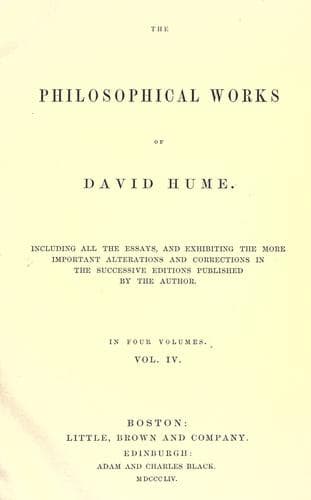
Philosophical Works, v. 1 (of 4): Including All the Essays, and Exhibiting the More Important Alterations and Corrections in the Successive Editions Published by the AuthorHume, David
PhilosophyPhilosophy
Philosophical Works, v. 1 (of 4): Including All the Essays, and Exhibiting the More Important Alterations and Corrections in the Successive Editions Published by the Author
Hume, David
Knowledge, Theory of; Philosophy, English -- 18th century
The same evidence follows us in our second principle, _of the liberty
of the imagination to transpose and change its ideas_. The fables we
meet with in poems and romances put this entirely out of question.
Nature there is totally confounded, and nothing mentioned but winged
horses, fiery dragons, and monstrous giants. Nor will this liberty of
the fancy appear strange, when we consider, that all our ideas are
copied from our impressions, and that there are not any two impressions
which are perfectly inseparable. Not to mention, that this is an
evident consequence of the division of ideas into simple and complex.
Wherever the imagination perceives a difference among ideas, it can
easily produce a separation.
[2] Part III. Sect. 5.
SECTION IV.
OF THE CONNEXION OR ASSOCIATION OF IDEAS.
As all simple ideas may be separated by the imagination, and may
be united again in what form it pleases, nothing would be more
unaccountable than the operations of that faculty, were it not guided
by some universal principles, which render it, in some measure, uniform
with itself in all times and places. Were ideas entirely loose and
unconnected, chance alone would join them; and 'tis impossible the same
simple ideas should fall regularly into complex ones (as they commonly
do), without some bond of union among them, some associating quality,
by which one idea naturally introduces another. This uniting principle
among ideas is not to be considered as an inseparable connexion; for
that has been already excluded from the imagination: nor yet are we to
conclude, that without it the mind cannot join two ideas; for nothing
is more free than that faculty: but we are only to regard it as a
gentle force, which commonly prevails, and is the cause why, among
other things, languages so nearly correspond to each other; Nature,
in a manner, pointing out to every one those simple ideas, which are
most proper to be united into a complex one. The qualities, from which
this association arises, and by which the mind is, after this manner,
conveyed from one idea to another, are three, viz. _resemblance,
contiguity_ in time or place, and _cause_ and _effect_.
Public-domain text, read in full here on John Shaqi.
Reviews
Reviews
No reviews yet
Be the first to share your thoughts on this work.
Elsewhere in the archive
Join the Discussion
Join the discussion
Sign in to leave a comment or review.
Sign InorCreate an account