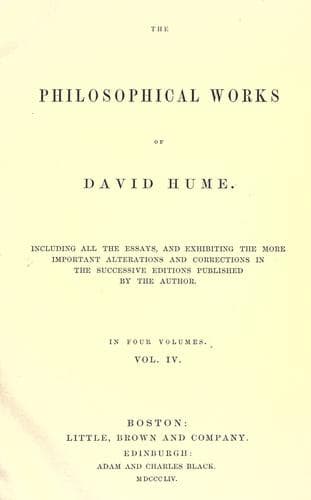
Philosophical Works, v. 1 (of 4): Including All the Essays, and Exhibiting the More Important Alterations and Corrections in the Successive Editions Published by the AuthorHume, David
PhilosophyPhilosophy
Philosophical Works, v. 1 (of 4): Including All the Essays, and Exhibiting the More Important Alterations and Corrections in the Successive Editions Published by the Author
Hume, David
Knowledge, Theory of; Philosophy, English -- 18th century
I believe it will not be very necessary to prove, that these qualities
produce an association among ideas, and, upon the appearance of one
idea, naturally introduce another. 'Tis plain, that, in the course
of our thinking, and in the constant revolution of our ideas, our
imagination runs easily from one idea to any other that _resembles_
it, and that this quality alone is to the fancy a sufficient bond and
association. 'Tis likewise evident, that as the senses, in changing
their objects, are necessitated to change them regularly, and take them
as they lie _contiguous_ to each other, the imagination must, by long
custom, acquire the same method of thinking, and run along the parts
of space and time in conceiving its objects. As to the connexion that
is made by the relation of _cause and effect_, we shall have occasion
afterwards to examine it to the bottom, and therefore shall not at
present insist upon it. 'Tis sufficient to observe, that there is no
relation, which produces a stronger connexion in the fancy, and makes
one idea more readily recal another, than the relation of cause and
effect betwixt their objects.
That we may understand the full extent of these relations, we must
consider, that two objects are connected together in the imagination,
not only when the one is immediately resembling, contiguous to, or the
cause of the other, but also when there is interposed betwixt them a
third object, which bears to both of them any of these relations. This
may be carried on to a great length; though, at the same time we may
observe, that each remove considerably weakens the relation. Cousins
in the fourth degree are connected by _causation_, if I may be allowed
to use that term; but not so closely as brothers, much less as child
and parent. In general, we may observe, that all the relations of
blood depend upon cause and effect, and are esteemed near or remote,
according to the number of connecting causes interposed betwixt the
persons.
Of the three relations above mentioned this of causation is the most
extensive. Two objects may be considered as placed in this relation,
as well when one is the cause of any of the actions or motions of
the other, as when the former is the cause of the existence of the
latter. For as that action or motion is nothing but the object
itself, considered in a certain light, and as the object continues
the same in all its different situations, 'tis easy to imagine how
such an influence of objects upon one another may connect them in the
imagination.
Public-domain text, read in full here on John Shaqi.
Reviews
Reviews
No reviews yet
Be the first to share your thoughts on this work.
Elsewhere in the archive
Join the Discussion
Join the discussion
Sign in to leave a comment or review.
Sign InorCreate an account