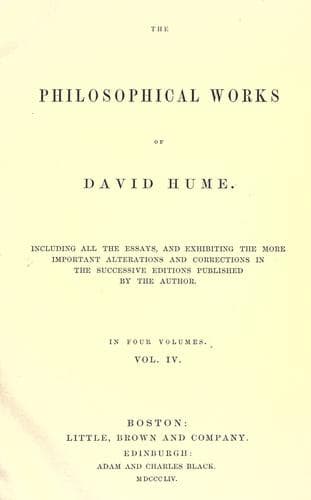
Philosophical Works, v. 1 (of 4): Including All the Essays, and Exhibiting the More Important Alterations and Corrections in the Successive Editions Published by the AuthorHume, David
PhilosophyPhilosophy
Philosophical Works, v. 1 (of 4): Including All the Essays, and Exhibiting the More Important Alterations and Corrections in the Successive Editions Published by the Author
Hume, David
Knowledge, Theory of; Philosophy, English -- 18th century
We may carry this farther, and remark, not only that two objects are
connected by the relation of cause and effect, when the one produces
a motion or any action in the other, but also when it has a power of
producing it. And this we may observe to be the source of all the
relations of interest and duty, by which men influence each other in
society, and are placed in the ties of government and subordination.
A master is such a one as, by his situation, arising either from
force or agreement, has a power of directing in certain particulars
the actions of another, whom we call servant. A judge is one, who, in
all disputed cases, can fix by his opinion the possession or property
of any thing betwixt any members of the society. When a person is
possessed of any power, there is no more required to convert it into
action, but the exertion of the will; and _that_ in every case is
considered as possible, and in many as probable; especially in the case
of authority, where the obedience of the subject is a pleasure and
advantage to the superior.
These are, therefore, the principles of union or cohesion among
our simple ideas, and in the imagination supply the place of that
inseparable connexion, by which they are united in our memory. Here
is a kind of _attraction_, which in the mental world will be found to
have as extraordinary effects as in the natural, and to show itself in
as many and as various forms. Its effects are every where conspicuous;
but, as to its causes, they are mostly unknown, and must be resolved
into _original_ qualities of human nature, which I pretend not to
explain. Nothing is more requisite for a true philosopher, than to
restrain the intemperate desire of searching into causes; and, having
established any doctrine upon a sufficient number of experiments, rest
contented with that, when he sees a farther examination would lead him
into obscure and uncertain speculations. In that case his inquiry would
be much better employed in examining the effects than the causes of his
principle.
Amongst the effects of this union or association of ideas, there are
none more remarkable than those complex ideas, which are the common
subjects of our thoughts and reasoning, and generally arise from some
principle of union among our simple ideas. These complex ideas may be
divided into _relations, modes,_ and _substances_. We shall briefly
examine each of these in order, and shall subjoin some considerations
concerning our _general_ and _particular_ ideas, before we leave the
present subject, which may be considered as the elements of this
philosophy.
SECTION V.
OF RELATIONS.
Public-domain text, read in full here on John Shaqi.
Reviews
Reviews
No reviews yet
Be the first to share your thoughts on this work.
Elsewhere in the archive
Join the Discussion
Join the discussion
Sign in to leave a comment or review.
Sign InorCreate an account