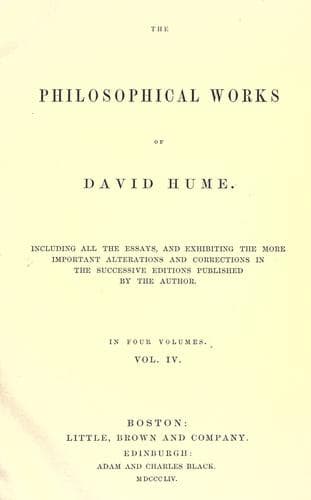
Philosophical Works, v. 1 (of 4): Including All the Essays, and Exhibiting the More Important Alterations and Corrections in the Successive Editions Published by the AuthorHume, David
PhilosophyPhilosophy
Philosophical Works, v. 1 (of 4): Including All the Essays, and Exhibiting the More Important Alterations and Corrections in the Successive Editions Published by the Author
Hume, David
Knowledge, Theory of; Philosophy, English -- 18th century
The word _relation_ is commonly used in two senses considerably
different from each other. Either for that quality, by which two ideas
are connected together in the imagination, and the one naturally
introduces the other, after the manner above explained; or for that
particular circumstance, in which, even upon the arbitrary union of
two ideas in the fancy, we may think proper to compare them. In common
language, the former is always the sense in which we use the word
relation; and 'tis only in philosophy that we extend it to mean any
particular subject of comparison, without a connecting principle. Thus,
distance will be allowed by philosophers to be a true relation, because
we acquire an idea of it by the comparing of objects: but in a common
way we say, _that nothing can be more distant than such or such things
from each other, nothing can have less relation_; as if distance and
relation were incompatible.
It may, perhaps, be esteemed an endless task to enumerate all those
qualities, which make objects admit of comparison, and by which the
ideas of _philosophical_ relation are produced. But if we diligently
consider them we shall find, that without difficulty they may be
comprised under seven general heads, which may be considered as the
sources of all philosophical relation.
1. The first is _resemblance_: and this is a relation, without which
no philosophical relation can exist, since no objects will admit of
comparison, but what have some degree of resemblance. But though
resemblance be necessary to all philosophical relation, it does not
follow that it always produces a connexion or association of ideas.
When a quality becomes very general, and is common to a great many
individuals, it leads not the mind directly to any one of them; but,
by presenting at once too great a choice, does thereby prevent the
imagination from fixing on any single object.
2. _Identity_ may be esteemed a second species of relation. This
relation I here consider as applied in its strictest sense to constant
and unchangeable objects; without examining the nature and foundation
of personal identity, which shall find its place afterwards. Of all
relations the most universal is that of identity, being common to every
being, whose existence has any duration.
3. After identity the most universal and comprehensive relations are
those of _space_ and _time_, which are the sources of an infinite
number of comparisons, such as _distant, contiguous, above, below,
before, after, &c_.
4. All those objects, which admit of _quantity_ or _number_, may be
compared in that particular, which is another very fertile source of
relation.
Public-domain text, read in full here on John Shaqi.
Reviews
Reviews
No reviews yet
Be the first to share your thoughts on this work.
Elsewhere in the archive
Join the Discussion
Join the discussion
Sign in to leave a comment or review.
Sign InorCreate an account