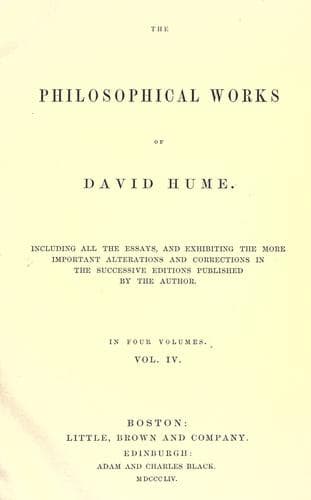
Philosophical Works, v. 1 (of 4): Including All the Essays, and Exhibiting the More Important Alterations and Corrections in the Successive Editions Published by the AuthorHume, David
PhilosophyPhilosophy
Philosophical Works, v. 1 (of 4): Including All the Essays, and Exhibiting the More Important Alterations and Corrections in the Successive Editions Published by the Author
Hume, David
Knowledge, Theory of; Philosophy, English -- 18th century
Nay so entire is the custom, that the very same idea may be annexed to
several different words, and may be employed in different reasonings,
without any danger of mistake. Thus the idea of an equilateral triangle
of an inch perpendicular may serve us in talking of a figure, of a
rectilineal figure, of a regular figure, of a triangle, and of an
equilateral triangle. All these terms, therefore, are in this case
attended with the same idea; but as they are wont to be applied in a
greater or lesser compass, they excite their particular habits, and
thereby keep the mind in a readiness to observe, that no conclusion be
formed contrary to any ideas, which are usually comprised under them.
Before those habits have become entirely perfect, perhaps the mind may
not be content with forming the idea of only one individual, but may
run over several, in order to make itself comprehend its own meaning,
and the compass of that collection, which it intends to express by the
general term. That we may fix the meaning of the word, figure, we may
revolve in our mind the ideas of circles, squares, parallelograms,
triangles of different sizes and proportions, and may not rest on one
image or idea. However this may be, 'tis certain _that_ we form the
idea of individuals whenever we use any general term; _that_ we seldom
or never can exhaust these individuals; and _that_ those which remain,
are only represented by means of that habit by which we recal them,
whenever any present occasion requires it. This then is the nature of
our abstract ideas and general terms; and 'tis after this manner we
account for the foregoing paradox, _that some ideas are particular
in their nature, but general in their representation_. A particular
idea becomes general by being annexed to a general term; that is, to a
term which, from a customary conjunction, has a relation to many other
particular ideas, and readily recals them in the imagination.
The only difficulty that can remain on this subject, must be with
regard to that custom, which so readily recals every particular idea
for which we may have occasion, and is excited by any word or sound
to which we commonly annex it. The most proper method, in my opinion,
of giving a satisfactory explication of this act of the mind, is
by producing other instances which are analogous to it, and other
principles which facilitate its operation. To explain the ultimate
causes of our mental actions is impossible. 'Tis sufficient if we can
give any satisfactory account of them from experience and analogy.
First, then, I observe, that when we mention any great number, such as
a thousand, the mind has generally no adequate idea of it, but only a
power of producing such an idea, by its adequate idea of the decimals
under which the number is comprehended. This imperfection, however,
in our ideas, is never felt in our reasonings, which seems to be an
instance parallel to the present one of universal ideas.
Public-domain text, read in full here on John Shaqi.
Reviews
Reviews
No reviews yet
Be the first to share your thoughts on this work.
Elsewhere in the archive
Join the Discussion
Join the discussion
Sign in to leave a comment or review.
Sign InorCreate an account