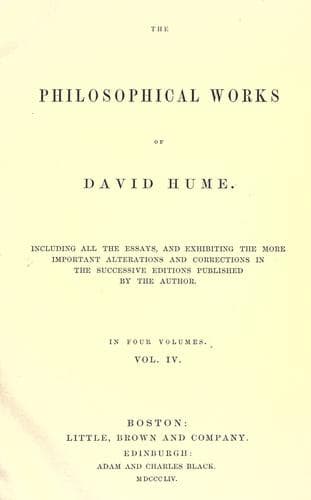
Philosophical Works, v. 1 (of 4): Including All the Essays, and Exhibiting the More Important Alterations and Corrections in the Successive Editions Published by the AuthorHume, David
PhilosophyPhilosophy
Philosophical Works, v. 1 (of 4): Including All the Essays, and Exhibiting the More Important Alterations and Corrections in the Successive Editions Published by the Author
Hume, David
Knowledge, Theory of; Philosophy, English -- 18th century
Secondly, we have several instances of habits which may be revived by
one single word; as when a person who has, by rote, any periods of
a discourse, or any number of verses, will be put in remembrance of
the whole, which he is at a loss to recollect, by that single word or
expression with which they begin.
Thirdly, I believe every one who examines the situation of his mind
in reasoning, will agree with me, that we do not annex distinct and
complete ideas to every term we make use of, and that in talking
of _government, church, negociation, conquest_, we seldom spread
out in our minds all the simple ideas of which these complex ones
are composed. 'Tis however observable, that notwithstanding this
imperfection, we may avoid talking nonsense on these subjects, and may
perceive any repugnance among the ideas as well as if we had a full
comprehension of them. Thus, if instead of saying, _that in war the
weaker have always recourse to negociation_, we should say, _that they
have always recourse to conquest_, the custom which we have acquired of
attributing certain relations to ideas, still follows the words, and
makes us immediately perceive the absurdity of that proposition; in the
same manner as one particular idea may serve us in reasoning concerning
other ideas, however different from it in several circumstances.
Fourthly, as the individuals are collected together, and placed under
a general term with a view to that resemblance which they bear to each
other, this relation must facilitate their entrance in the imagination,
and make them be suggested more readily upon occasion. And, indeed, if
we consider the common progress of the thought, either in reflection
or conversation, we shall find great reason to be satisfied in this
particular. Nothing is more admirable than the readiness with which the
imagination suggests its ideas, and presents them at the very instant
in which they become necessary or useful. The fancy runs from one end
of the universe to the other, in collecting those ideas which belong to
any subject. One would think the whole intellectual world of ideas was
at once subjected to our view, and that we did nothing but pick out
such as were most proper for our purpose. There may not, however, be
any present, beside those very ideas, that are thus collected by a kind
of magical faculty in the soul, which, though it be always most perfect
in the greatest geniuses, and is properly what we call a genius, is
however inexplicable by the utmost efforts of human understanding.
Public-domain text, read in full here on John Shaqi.
Reviews
Reviews
No reviews yet
Be the first to share your thoughts on this work.
Elsewhere in the archive
Join the Discussion
Join the discussion
Sign in to leave a comment or review.
Sign InorCreate an account