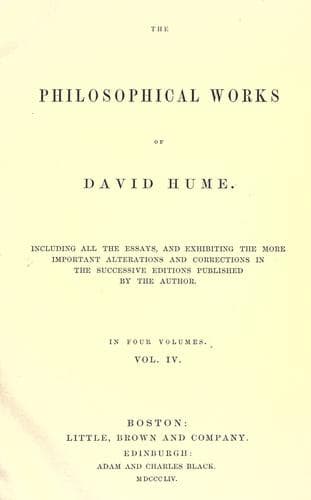
Philosophical Works, v. 1 (of 4): Including All the Essays, and Exhibiting the More Important Alterations and Corrections in the Successive Editions Published by the AuthorHume, David
PhilosophyPhilosophy
Philosophical Works, v. 1 (of 4): Including All the Essays, and Exhibiting the More Important Alterations and Corrections in the Successive Editions Published by the Author
Hume, David
Knowledge, Theory of; Philosophy, English -- 18th century
Perhaps these four reflections may help to remove all difficulties to
the hypothesis I have proposed concerning abstract ideas, so contrary
to that which has hitherto prevailed in philosophy. But to tell the
truth, I place my chief confidence in what I have already proved
concerning the impossibility of general ideas, according to the common
method of explaining them. We must certainly seek some new system on
this head, and there plainly is none beside what I have proposed. If
ideas be particular in their nature, and at the same time finite in
their number, 'tis only by custom they can become general in their
representation, and contain an infinite number of other ideas under
them.
Before I leave this subject, I shall employ the same principles to
explain that _distinction of reason_, which is so much talked of, and
is so little understood in the schools. Of this kind is the distinction
betwixt figure and the body figured; motion and the body moved. The
difficulty of explaining this distinction arises from the principle
above explained, _that all ideas which are different are separable_.
For it follows from thence, that if the figure be different from
the body, their ideas must be separable as well as distinguishable;
if they be not different, their ideas can neither be separable nor
distinguishable. What then is meant by a distinction of reason, since
it implies neither a difference nor separation?
To remove this difficulty, we must have recourse to the foregoing
explication of abstract ideas. 'Tis certain that the mind would never
have dreamed of distinguishing a figure from the body figured, as being
in reality neither distinguishable, nor different, nor separable, did
it not observe, that even in this simplicity there might be contained
many different resemblances and relations. Thus, when a globe of white
marble is presented, we receive only the impression of a white colour
disposed in a certain form, nor are we able to separate and distinguish
the colour from the form. But observing afterwards a globe of black
marble and a cube of white, and comparing them with our former object,
we find two separate resemblances, in what formerly seemed, and really
is, perfectly inseparable. After a little more practice of this kind,
we begin to distinguish the figure from the colour by a _distinction
of reason_; that is, we consider the figure and colour together, since
they are, in effect, the same and undistinguishable; but still view
them in different aspects, according to the resemblances of which they
are susceptible. When we would consider only the figure of the globe of
white marble, we form in reality an idea both of the figure and colour,
but tacitly carry our eye to its resemblance with the globe of black
marble: and in the same manner, when we would consider its colour only,
we turn our view to its resemblance with the cube of white marble. By
this means we accompany our ideas with a kind of reflection, of which
Public-domain text, read in full here on John Shaqi.
Reviews
Reviews
No reviews yet
Be the first to share your thoughts on this work.
Elsewhere in the archive
Join the Discussion
Join the discussion
Sign in to leave a comment or review.
Sign InorCreate an account