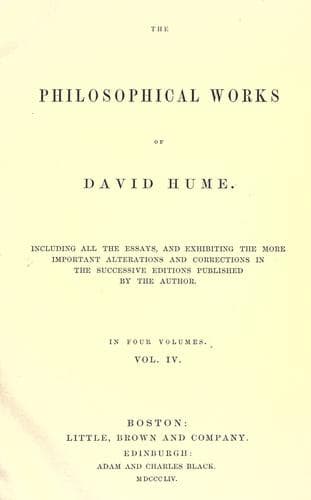
Philosophical Works, v. 1 (of 4): Including All the Essays, and Exhibiting the More Important Alterations and Corrections in the Successive Editions Published by the AuthorHume, David
PhilosophyPhilosophy
Philosophical Works, v. 1 (of 4): Including All the Essays, and Exhibiting the More Important Alterations and Corrections in the Successive Editions Published by the Author
Hume, David
Knowledge, Theory of; Philosophy, English -- 18th century
custom renders us, in a great measure, insensible. A person who desires
us to consider the figure of a globe of white marble without thinking
on its colour, desires an impossibility; but his meaning is, that we
should consider the colour and figure together, but still keep in our
eye the resemblance to the globe of black marble, or that to any other
globe of whatever colour or substance.
[3] Dr Berkeley.
[4] 'Tis evident, that even different simple ideas may have a
similarity or resemblance to each other; nor is it necessary, that the
point or circumstance of resemblance should be distinct or separable
from that in which they differ. _Blue_ and _green_ are different simple
ideas, but are more resembling than _blue_ and _scarlet_; though
their perfect simplicity excludes all possibility of separation or
distinction. 'Tis the same case with particular sounds, and tastes,
and smells. These admit of infinite resemblances upon the general
appearance and comparison, without having any common circumstance
the same. And of this we may be certain, even from the very abstract
terms _simple idea_. They comprehend all simple ideas under them.
These resemble each other in their simplicity. And yet from their very
nature, which excludes all composition, this circumstance, in which
they resemble, is not distinguishable or separable from the rest.
'Tis the same case with all the degrees in any quality. They are all
resembling, and yet the quality, in any individual, is not distinct
from the degree.
PART II.
OF THE IDEAS OF SPACE AND TIME.
SECTION I.
OF THE INFINITE DIVISIBILITY OF OUR IDEAS OF SPACE AND TIME.
Whatever has the air of a paradox, and is contrary to the first and
most unprejudiced notions of mankind, is often greedily embraced by
philosophers, as showing the superiority of their science, which could
discover opinions so remote from vulgar conception. On the other hand,
any thing proposed to us, which causes surprise and admiration, gives
such a satisfaction to the mind, that it indulges itself in those
agreeable emotions, and will never be persuaded that its pleasure is
entirely without foundation. From these dispositions in philosophers
and their disciples, arises that mutual complaisance betwixt them;
while the former furnish such plenty of strange and unaccountable
opinions, and the latter so readily believe them. Of this mutual
complaisance I cannot give a more evident instance than in the doctrine
of infinite divisibility, with the examination of which I shall begin
this subject of the ideas of space and time.
Public-domain text, read in full here on John Shaqi.
Reviews
Reviews
No reviews yet
Be the first to share your thoughts on this work.
Elsewhere in the archive
Join the Discussion
Join the discussion
Sign in to leave a comment or review.
Sign InorCreate an account