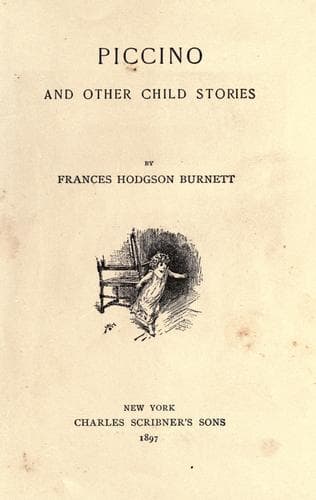
Piccino, and other child storiesBurnett, Frances Hodgson
General
Piccino, and other child stories
Burnett, Frances Hodgson
Children -- Conduct of life -- Juvenile fiction; Children's stories, American
She was a person who through all her life had cultivated the habit of
getting all she had a fancy for. If one cultivates the habit, and has
plenty of money, there are not many things one cannot have. There are
some, it is true, but not many. Lady Aileen had not found many. Just
now she was rather more bored than usual. Before she had left England
something had occurred which had rather troubled her. In fact, she had
come to the Riviera to forget it in change of surroundings. She had
been to Monte Carlo and had found it too exciting and not new enough,
as she had been there often before. She had been to Nice, and had said
it was too much like a seaside Paris, and that there were so many
English people that walking down the Promenade des Anglais was like
walking down Bond Street. She had tried San Remo because it was quiet,
and she had a temporary fancy for being quiet, and then she had chanced
to meet some people she liked. So she had taken a snow-white villa high
above the sea, and with palms and orange-trees and slender yellow-green
bamboos in the garden. And she had invited her new acquaintances to
dinner and afternoon tea, and had made up excursions. Still, she was
often bored, and wanted some new trifle to amuse her. And actually,
when she saw Piccino, and Mr. Gordon suggested to her that she
should buy him, it occurred to her that she would try it. If she had
chanced to come upon a tiny, pretty, rare monkey or toy terrier, or
an unheard-of kind of parrot or cockatoo, she would have tried the
experiment of buying it; and Piccino, with his dirty, beautiful little
face and his half-inch eyelashes, did not seem much more serious to
her. He would cost more money, of course, as she would have to provide
for him in some way after he had grown too big to amuse her; but she
had plenty of money, and she need not trouble herself about him. She
need not see him if she did not wish to, after she had sent him to
school, or to be trained into some kind of superior servant. Lady
Aileen was not a person whose conscience disturbed her, and caused her
to feel responsibilities. And so, after the party had been to explore
Ceriani and the things that otherwise interested them, she asked Mr.
Gordon to go with her to the poor little tumble-down house which Maria
had pointed out to her as the home of Piccino. Maria had, in fact,
had a rich harvest. Everybody had returned full of good things, and
Piccino’s small pocket was rich with _soldi_.
“I am going to carry out your suggestion,” Lady Aileen said to Mr.
Gordon, as they walked down the road.
“What was it?” Mr. Gordon asked.
“That I should buy the child.”
“Indeed,” said Mr. Gordon. “You find you can always buy what you have a
fancy for?”
“Nearly always,” said Lady Aileen, knitting her handsome white forehead
a little; “I have no doubt I can buy this thing I have a fancy for.”
Public-domain text, read in full here on John Shaqi.
Reviews
Reviews
No reviews yet
Be the first to share your thoughts on this work.
Join the Discussion
Join the discussion
Sign in to leave a comment or review.
Sign InorCreate an account