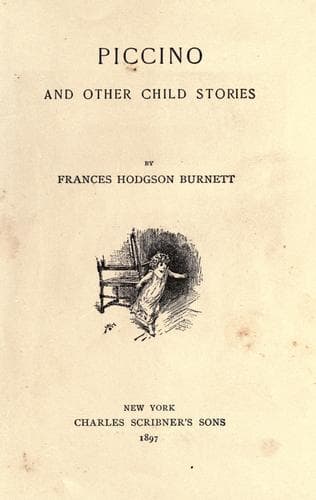
Piccino, and other child storiesBurnett, Frances Hodgson
General
Piccino, and other child stories
Burnett, Frances Hodgson
Children -- Conduct of life -- Juvenile fiction; Children's stories, American
It chanced that she came exactly at the right moment. As they
approached the house they heard even louder cries and lamentations and
railings than Piccino had heard in the morning.
It appeared that old Beppo had repented his leniency and had come back
for the donkey. He would not let it stay another night. He wanted to
work it himself. He had brought his piece of rope and had fastened it
to the pretty gray head already, while Piccino’s mother, Rita, wept and
gesticulated and poured forth maledictions. The neighbors had come back
to sympathize with her and find out what would happen, and the children
had begun to cry and Annibale to swear, so that there was such a noise
filling the air that if Lady Aileen had not been a cool and determined
person she might have been alarmed.
But she was not. She did not wait for Mr. Gordon to command order, but
walked straight into the midst of the altercation.
“What is the matter?” she demanded in Italian, “what is all this noise
about?”
Then, after their first start of surprise at seeing the grand lady, who
was so plainly one of the rich _forestieri_, Rita and all her neighbors
began to explain their wrongs at once. They praised the donkey and
reviled Annibale, and proclaimed that old Beppo was a malefactor
without a soul, and a robber of the widow and the fatherless.
“Far better,” cried Rita, “that my children should be without a father.
An idle, ugly brute, who takes their bread out of their poor mouths. To
sell their one friend who keeps them—the donkey!”
Old Beppo looked both sheepish and frightened when Lady Aileen turned
upon him as he was beginning to try to shuffle away with his property
at the end of his rope halter.
“Stay where you are!” she said.
“_Illustrissima_,” mumbled Beppo, “a thousand excuses. But I have work
to do, and the donkey is mine. I have bought it. It is my donkey,
_illustrissima_.”
Lady Aileen knew Italy very well. She drew out her purse, that he might
see it in her hand, before she turned away from him.
“Stay where you are,” she said. “I shall have something to say to you
later.”
Then she turned to Rita.
“Stop making a noise,” she said. “I want to talk to you.”
“What could the illustrious signora have to say to a wretched woman?”
Rita wept. “All her children must starve; she must starve herself;
death from cold and hunger lay before them!”
“No such thing,” said Lady Aileen. “I will buy your donkey back, and
give you food and fuel for the winter—for more than one winter—if you
will let me have what I want.”
Rita and the neighbors exclaimed in chorus. If she could have what she
wanted, the most illustrious signora! What could she want that a hovel
could hold, and what could such poor creatures refuse her?
Lady Aileen made a gesture towards Piccino, who had gone to stand by
the donkey, and had big tears on his eyelashes as he fondled its nose.
Public-domain text, read in full here on John Shaqi.
Reviews
Reviews
No reviews yet
Be the first to share your thoughts on this work.
Join the Discussion
Join the discussion
Sign in to leave a comment or review.
Sign InorCreate an account