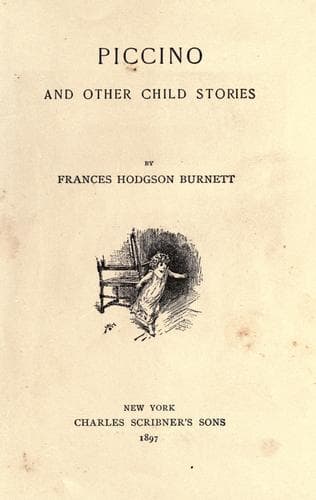
Piccino, and other child storiesBurnett, Frances Hodgson
General
Piccino, and other child stories
Burnett, Frances Hodgson
Children -- Conduct of life -- Juvenile fiction; Children's stories, American
And it was through these excursion parties that Piccino’s market
value was discovered. When he was a baby and his sister Maria, who
was his small nurse—being determined not to be left behind by her
comrades—toiled after the rest of the children with her little burden
in her arms or over her shoulder, it was observed that the _forestieri_
always saw the pretty round black baby head and big soft dark eyes
before they saw anything else, and their attention once attracted by
Piccino very pleasant things were often the result. The whole party
got more cakes and sandwiches and legs of chickens and backs of little
birds, and when bits of silver were given to Maria for Piccino, Maria
herself sometimes even had whole francs given to her, because it was
she who was his sister and took care of him. And then, having begun
giving, the good-natured ones among the party of ladies and gentlemen
did not like to quite neglect the other children, and so scattered
_soldi_ among them, so that sometimes they all returned to Ceriani
feeling that they had done a good day’s work. Their idea of a good
day’s work was one when they had not run after carriages for nothing,
or had heads shaken at them when they held out their hands and called
imploringly, “_Uno soldino, bella signora—bella signora!_” Piccino had
been born one of the class which in its childhood and often even later
never fails in the belief that the English and Americans who come to
the beautiful Riviera come there to be begged from, or in some way
beguiled out of their small coin.
Maria was a sharp child. She had not lugged her little brothers and
sisters about all through the working time of her twelve years without
learning a few things. She very soon found out what it was that brought
in the _soldi_ and the nice scraps from the hampers.
“It is Piccino they give things to—_ecco_!” she said. “They see his
eyes and they want to look at him and touch his cheeks. They like to
see the dimples come when he laughs. They would not look at me like
that, or at you, Carmela. They would not come near us.”
This was quite true. The row of little spectators watching the picnics
might be picturesque, but it was exceedingly dirty, and not made up of
the material it is quite safe to come near. It was a belief current
among the parties who drove up from San Remo that soap had never been
heard of in the vicinity of Ceriani and that water was avoided as a
poisonous element, and this belief was not founded upon mere nothings.
“They are as dirty as they are cheerful and impudent,” some one had
said, “and that is saying a great deal. I wonder what would happen if
one of them were caught and washed all over.”
Public-domain text, read in full here on John Shaqi.
Reviews
Reviews
No reviews yet
Be the first to share your thoughts on this work.
Join the Discussion
Join the discussion
Sign in to leave a comment or review.
Sign InorCreate an account