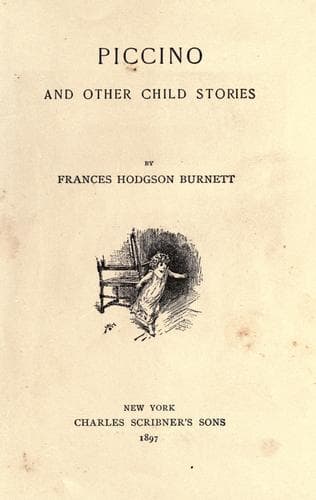
Piccino, and other child storiesBurnett, Frances Hodgson
General
Piccino, and other child stories
Burnett, Frances Hodgson
Children -- Conduct of life -- Juvenile fiction; Children's stories, American
Nobody could have been dirtier than Piccino was. Pretty as he looked,
there were days when the most enthusiastic of the ladies dare not have
taken him in her arms. In fact, there were very few days when any one
would have liked to go quite that far—or any farther, indeed, than
looking at his velvet eyes and throwing him _soldi_ and cakes. But his
eyes always won him the _soldi_ and cakes, and the older he grew the
more he gained, so that not only Maria and her companions, but his
mother herself, began to look upon him as a source of revenue.
“If he can only sing when he grows a little older,” his mother said,
“he can fill his pockets full by going and singing before the hotels
and in the gardens of the villas. Every one will give him something.
They are a queer lot, these foreigners, who are willing to give good
money to a child because he has long eyelashes. His are long enough,
thanks to the Virgin! Sometimes I wonder they are not in his way.”
His mother was the poorest of the poor. She had seven children, and a
mere hovel to put them in, and nothing to feed and clothe them with.
Her husband was a good-for-nothing, who never worked if he could help
it, and who, if he earned a few _soldi_, got rid of them at once
before they could be scolded out of him and spent on such extravagances
as food and fire. If Piccino had not been a little Italian peasant he
would, no doubt, have starved to death or died of cold long before he
had his adventure; but on the Riviera the sun shines and the air is
soft, and people seem born with a sort of gay carelessness of most
things that trouble the serious world.
As for Piccino, he was as happy as a soft little rabbit or a young bird
or a baby fawn. When he was old enough to run about, he had the most
beautiful days. They seemed to him to be made up of warm sunshine and
warm grass, flowers looking at him as he toddled round, light filtering
through vines and the branches of olive-trees, nice black bread and
figs, which he lay on his back and munched delightedly, and days when
Maria dragged him along the road to some green place where grand
people sat and ate good things, and who afterwards gave him cakes and
delicious little bones and _soldi_, saying over and over again to each
other that he was the prettiest little boy they had ever seen, and had
the most beautiful eyes, and oh! his eyelashes!
“Look at his eyelashes!” they would exclaim. “They are as thick as
rushes round a pool, and they must be half an inch long.”
Public-domain text, read in full here on John Shaqi.
Reviews
Reviews
No reviews yet
Be the first to share your thoughts on this work.
Join the Discussion
Join the discussion
Sign in to leave a comment or review.
Sign InorCreate an account