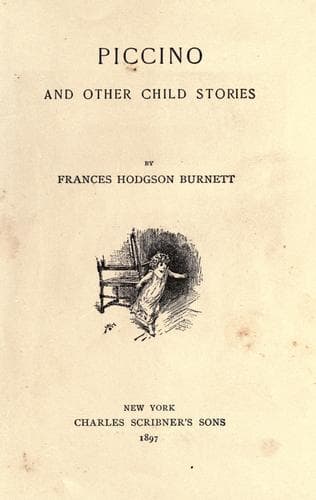
Piccino, and other child storiesBurnett, Frances Hodgson
General
Piccino, and other child stories
Burnett, Frances Hodgson
Children -- Conduct of life -- Juvenile fiction; Children's stories, American
And this was far from being the end of it. Little by little I began to
hear a whisper here and there, even among the men, about what people
said of Captain Roscoe being so friendly with the Dalgettys, and
partic’ler with Miss Rosie. There was not one of them but said that it
would do the pretty young creature no good, if it did her no harm, to
be so ready to let him be attentive. He had been such an open rascal in
his time, and his character was so well known, that no careful mother
would have let her daughter be seen with him, and he was only tolerated
in his own set, and among those who were as bad as himself. But Mrs.
Dalgetty was too thoughtless and indifferent to see the wrong in
him, or to be troubled by what she heard, and the captain was rarely
at home; so Miss Rose was left to herself, and, of course, did as any
other innocent girl would have done, fell in love with a handsome face,
and believed in it.
But at last so much was said by outsiders that something came to the
captain’s ears as must have roused him, for one evening he comes up to
the house in a towering rage, and shuts himself up with Miss Rose and
her mother in the parlor, and has a tremendous row, and makes them both
cry, and ends up by forbidding them to speak to Roscoe again.
But though Mrs. Dalgetty gave in, as she always did when the captain
gave his orders, of course Miss Rose would not believe anything against
her lover. Things had gone so far by that time that she would have
stood out for him against the whole world; and as she dared not openly
disobey her father, she fretted until she lost her pretty color and
bright spirits, and went about the house looking ill and wretched.
But the matter was not put an end to, as you may imagine. Once or
twice, in going from the house to the barracks, I found Captain Basil
Roscoe loitering about not far from the street’s end, and more than
once I could have sworn that I passed him at dusk with a familiar
little figure clinging to his arm. And one night Miss Rosie calls her
brother to her, as he was going out on an errand, and, as she bends
over him in the doorway, slips a note into his hand, crying pitifully.
“You will take that for me, won’t you, dear?” she says. “He is waiting
in the square for it, and he does want it so—so much.” And she kisses
him, and gives a little sob and runs up-stairs.
I don’t think it could have been more than three minutes after that
when he comes to me, all pale and breathless with running, and lays
that there note on the table.
“She wants me to take it to him, Rabbett,” he says, “and she was crying
when she asked me, and—what must we do?”
It is not to be expected as we two hadn’t talked things over, being the
friends we were. I got up and took the note from the table, making a
resolution all of a sudden.
Public-domain text, read in full here on John Shaqi.
Reviews
Reviews
No reviews yet
Be the first to share your thoughts on this work.
Join the Discussion
Join the discussion
Sign in to leave a comment or review.
Sign InorCreate an account