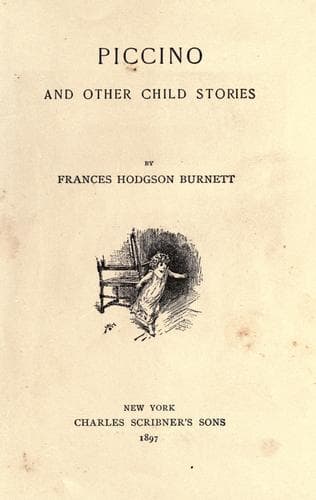
Piccino, and other child storiesBurnett, Frances Hodgson
General
Piccino, and other child stories
Burnett, Frances Hodgson
Children -- Conduct of life -- Juvenile fiction; Children's stories, American
“If you’ll stay here, sir,” I said, “I’ll take it myself.” And take it
I did, and found the rascal waiting, as Miss Rose had said he would be.
He gave a black enough scowl when he saw it were me, and it certainly
didn’t die out when I spoke to him.
“Sir,” says I, “I’ve come here on a poor errand, and I’ve come
unwilling enough, God knows. I’ve got a note in my hand here—a pitiful
little letter from a trusting, innocent girl to a man who, if he does
not mean her harm, surely cannot mean her good, or he would not be
leading her to meet him, and write to him in underhand ways. And I’ve
been making up my mind, as I came along, to make a appeal to that man,
as surely he’ll listen to if he has a man’s heart in his breast. She is
scarcely more than a child, sir, and she knows nothing of the world.
Leave her alone, and she may be a happy woman; go on as you’ve begun,
and it will be death and heartbreak to her, and her wrongs will lie at
your door.”
He stands there and looks at me, and by the light of the lamp we
was standing under I sees his handsome, devilish face, sneering and
triumphing and scorning me, as if I was a worm in the dirt under his
feet.
“My good fellow,” he says, “you are a little too late. Hand me that
letter, and be off, before I find it necessary to help you. How you got
hold of the note I don’t know, but I _do_ know it was never given to
you to deliver, and that I should be well warranted in kicking you back
to your quarters, for your deuced impudence and presumption.”
But I held to the letter tight.
“Very well, sir,” I answers, respectful, but firm as a rock. “This
letter goes back to the house, and before night is over the captain
will have read it himself, and can judge for himself what is best——”
I didn’t finish, for the next thing I knew was that he strode up to me
and grasped hold of me by my collar, and the minute I saw what he meant
to do I felt I had made a mistake in bringing the letter at all, and in
fancying that any appeal could touch or move him. There was a struggle
between us, but it did not last long; he being strong and lithe, and
so much the younger man, gave me no chance; and it were scarcely three
seconds before he threw me on the pavement, and leaving me there, a
trifle stunned, walked off with the letter in his hand.
I knew things must be pretty bad then. He would never have been so
desperate and determined if he had not meant to do his worst, and when
I made my way back I felt sick with fear. Master Lionel was sitting by
the bit of fire in the grate when I opened the door, and he turns round
and looks at me, and changes color.
“Rabbett,” he says, “there is blood on your face.”
“Perhaps so, sir,” I says. “I’ve had a fall.”
And then I sits down and tells him all about it; about what I had meant
to do, and what I had done, and I ends up by asking him what he thinks
we had better do, now that my plans had failed.
Public-domain text, read in full here on John Shaqi.
Reviews
Reviews
No reviews yet
Be the first to share your thoughts on this work.
Join the Discussion
Join the discussion
Sign in to leave a comment or review.
Sign InorCreate an account