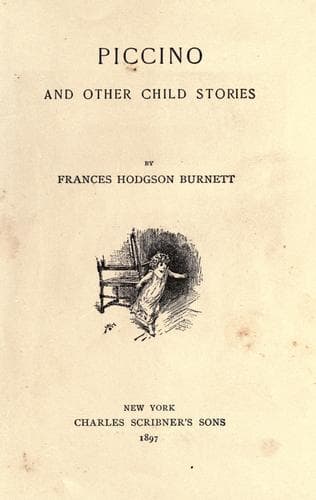
Piccino, and other child storiesBurnett, Frances Hodgson
General
Piccino, and other child stories
Burnett, Frances Hodgson
Children -- Conduct of life -- Juvenile fiction; Children's stories, American
Standing upon the top step was an exceedingly dilapidated and
disreputable little negro girl with an exceedingly dirty and broken
basket on her arm. This basket was intended to contain such scraps of
food as she might beg for. She was grinning a little, and at the same
time looking a little anxious, as the baby came toddling to her, the
sun on his short curls, the loaf under his short arm.
[Illustration: HIS INITIAL ACT OF CHARITY: “LADY,” HE SAID, “LADY,
F’ONT DOOR—WANT B’EAD”]
He dropped the loaf into her basket with sweet friendliness.
“B’ead, lady,” he said. And as she scurried away he turned to smile at
his approaching mamma with the confidence of a two-year-old angel.
“Lady, b’ead,” he remarked succinctly, and the situation was explained.
The dirty little colored girl was a human thing in petticoats,
consequently she was a lady. His tender mind saw no other conclusion
to be arrived at. She had expressed a desire for bread. On his mamma’s
breakfast table there was a beautiful long loaf. Of course it must be
given to her. The question of demand and supply was so easily settled;
so he trotted after the bread. The mere circumstances of short legs and
short arms did not deter a spirit like his.
And it was this simple and unquestioning point of view which made him
adorable.
CHAPTER II
IN WHITE FROCK AND SASH
In the drawing-room, in full war-paint of white frock and big sash, he
was the spirit of innocent and friendly hospitality, in the nursery
he was a brilliant entertainment, below stairs he was the admiration
and delight of the domestics. The sweet temper which prompted him to
endeavor to sustain agreeable conversation with the guest who admired
him led him, also, to enter into friendly converse with the casual
market-man at the back door, and to entertain with lively anecdote and
sparkling repartee the extremely stout colored cook in the kitchen.
He endeavored to assist her in the performance of her more arduous
culinary duties, and by his sympathy and interest sustained her in
many trying moments. When he was visiting her department chuckles and
giggles might be heard issuing from the kitchen when the door was
opened. Those who heard them always knew that they were excited by the
moral or social observations or affectionate advice and solace of the
young but distinguished guest.
“Me an’ Carrie made that pudding,” he would kindly explain, at dinner.
“It’s a very good pudding. Carrie’s such a nice cook. She lets me help
her.”
And his dimples would express such felicity, and his eyes beam from
under his tumbling love-locks with such pleasure, at his confidence
in the inevitable rapture of his parents at the announcement of his
active usefulness, that no one possessed sufficient strength of mind to
correct the grammatical structure of his remarks.
Public-domain text, read in full here on John Shaqi.
Reviews
Reviews
No reviews yet
Be the first to share your thoughts on this work.
Elsewhere in the archive
Join the Discussion
Join the discussion
Sign in to leave a comment or review.
Sign InorCreate an account