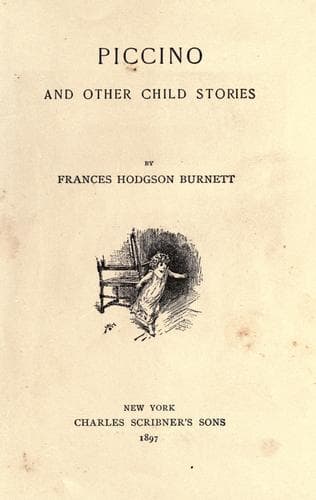
Piccino, and other child storiesBurnett, Frances Hodgson
General
Piccino, and other child stories
Burnett, Frances Hodgson
Children -- Conduct of life -- Juvenile fiction; Children's stories, American
Piccino did not know how long they were out together before Maria came
to find them. The donkey had a beautiful breakfast, and Piccino ate
his piece of black bread without anything to add to its flavor,
because his mother was at the time in great trouble and very poor,
and there was scarcely the bread itself to eat. Piccino toddled along
quite peacefully, however, and when he came upon a space where there
were red and yellow tulips swaying in the soft air he broke off a fine
handful, and when the donkey lay down he sat by it and began to stick
the beautiful, flaring things round his hat, as he had seen Maria stick
things round hers. It was a torn, soft felt hat, with a pointed crown
and a broad rim, and when he put it on again, with its adornment of red
and yellow flowers sticking up and down, and falling on his soft, thick
curls, he was a strangely beautiful little thing to see, and so like
a picture that he scarcely seemed like a real child at all, but like
a lovely, fantastic little being some artist had arranged to put on
canvas.
He was sitting in this way, looking out to where he could see a bit of
blue sea through a break in the hills, when Maria came running towards
him.
“The donkey!” she cried, “the donkey!”
She had been crying and looked excited, and took him by the hand,
dragging him towards home. His legs were so short and he was so little
that it always seemed as if she dragged him. She was an excitable
child, and always went fast when she had an object in view. Piccino
was used to excitement. They all shouted and screamed and gesticulated
at each other when any trifling thing happened. His mother and her
neighbors were given to tears and cries and loud ejaculations upon the
slightest provocation, as all Italian peasants are, so he saw nothing
unusual in Maria’s coming upon him like a whirlwind and exclaiming
disjointedly with tears. He wondered, however, what the donkey could
have to do with it, and evidently the donkey wondered too, for she got
up and trotted after them down the road.
But when they reached the house it was very plain that the thing which
had occurred was not a trifle, or usual.
Piccino saw an old man standing before the door talking to his mother.
At least, he was trying to get in a word edgeways now and then, while
the mother wept and beat her breast and poured forth a torrent of
bewailing, mingled with an avalanche of scolding addressed to her
husband, who stood near her, looking at once sheepish and ill-tempered.
“Worthless brute and pig,” she proclaimed; “idle, wicked animal, who
will not work to help me to feed his children. It is only I who work
and the donkey who helps me. Without her we should starve—starve! And
he sells her—poor beast!—sells her to get money for his wickedness and
gluttony. And I am to starve without her—a fine thing! And he brings to
my door the thief he has sold her to.”
Public-domain text, read in full here on John Shaqi.
Reviews
Reviews
No reviews yet
Be the first to share your thoughts on this work.
Join the Discussion
Join the discussion
Sign in to leave a comment or review.
Sign InorCreate an account