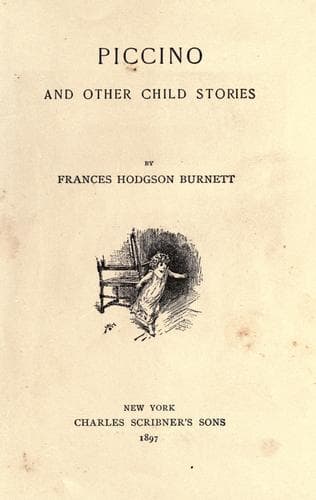
Piccino, and other child storiesBurnett, Frances Hodgson
General
Piccino, and other child stories
Burnett, Frances Hodgson
Children -- Conduct of life -- Juvenile fiction; Children's stories, American
Baby as he was, Piccino began to understand. His father had sold the
donkey, and it would be taken away. He lifted up his voice in a wail of
bitter lamentation, and breaking away from Maria ran to the donkey and
clung round her front leg, rubbing his cheek wofully against her gray
shoulder.
For an hour or so they all wept and lamented while their mother
alternately wept and raved. She abused her husband and the old man who
had bought the donkey, by turns. Stray neighbors dropped in and helped
her. They all agreed that old Beppo was a usurer and a thief, who had
somehow got the better of Annibale, who was also a drunken, shameless
brute. Old Beppo was so overwhelmed by the storm of hard words and bad
names raging about him that he actually was stunned into allowing that
the donkey should remain where she was for two days, that she might
finish some work her mistress had promised to do with her aid. And he
went away grumbling, with his piece of rope over his arm.
There was nothing to eat in the house, and if there had been, the
mother was too prostrate with grief and rage to have prepared anything
like a meal. And so it seemed a great piece of good luck when dirty
little Filippo burst upon them with the news that three grand carriages
full of illustrious-looking _forestieri_ and inviting hampers were
unloading themselves at a certain turn of the road, where the grass was
thick and the trees big and close together.
“Come!” said Maria, catching at Piccino’s hand. She gave him a look
over. His crying had left a flush in his soft cheeks and a little
pathetic curve on his baby mouth, which was always like a tiny
vermilion bow. His hat, with the tulips tumbling round it, was set
on the back of his head, and the red and yellow things made his eyes
look bigger and lovelier than ever by contrast. In these respects
Maria saw that he was good for more cakes and _soldi_ than ever. And
it would never have occurred to her that tears and rubbing against
the donkey had left him dirtier than ever. In Maria’s world nobody
troubled themselves about dirt. Washing one’s self amounted almost to a
religious ceremony. But ah! that little love of a Piccino was dirty—as
dirty as he was soft and dimpled and rich-colored and beautiful!
Near the place where the pleasure-seekers had spread their feast upon
the grass there was a low, rough, stone wall at the side of the road.
[Illustration: “PICCINO CLUNG TO THE DONKEY, RUBBING HIS CHEEK WOFULLY
AGAINST HER GRAY SHOULDER”]
When the servants had spread the bright rugs and cushions upon the
ground the party sat down in little groups. No sooner had they done
this than one of the ladies looked up and broke into a little laugh.
“Look there!” she said, nodding in the direction of the low wall, which
was only a few yards from them.
Public-domain text, read in full here on John Shaqi.
Reviews
Reviews
No reviews yet
Be the first to share your thoughts on this work.
Join the Discussion
Join the discussion
Sign in to leave a comment or review.
Sign InorCreate an account