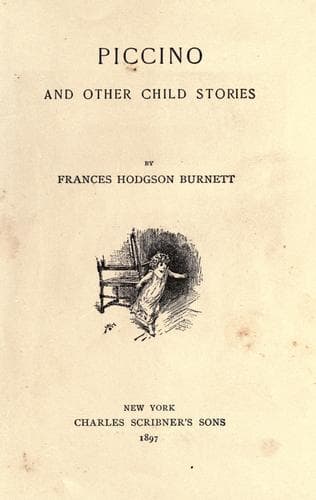
Piccino, and other child storiesBurnett, Frances Hodgson
General
Piccino, and other child stories
Burnett, Frances Hodgson
Children -- Conduct of life -- Juvenile fiction; Children's stories, American
“My dearest Mamma,” he wrote me in one of the splendid epistolary
efforts of his earliest years, “I am sorry that I have not had time
to write to you before. I have been so occupied with the presidential
election. The boys in my school knock me down and jump on me because
they want me to go Democrat. But I am still a strong Republican. I
send you a great many hugs and kisses.
“Your obedient and humble son and servant,
“VIVIAN.”
He was given to inventing picturesque terminations to his letters, and
he seemed particularly pleased with the idea of being my humble or
obedient son and servant. The picture the letter brought to my mind of
a flushed and tumbled but stanch little Republican engaged in a sort of
kindergarten political tussle with equally flushed and tumbled little
Democrats wore an extremely American aspect. Figuratively speaking,
he plunged into the thick of the electioneering fray. He engaged in
political argument upon all available occasions. Fortunately for his
peace of mind, Carrie and Dan favored the Republican party. Dan took
him to see Republican torchlight processions, and held him upon his
shoulders while he waved his small hat, his hair flying about his
glowing face while he shouted himself hoarse. No unworthy party cry
of “’Rah for Hancock!” went unanswered by the clarion response. At
the sound of such a cry in the street the nursery windows flew open
with a bang, and two ecstatic Republicans (himself and brother) almost
precipitated themselves into space, shouting “’Rah for Garfield!”
Without such precautions he felt his party would be lost. I think he
was six when he discovered that he was a supporter of the movement
in favor of female suffrage. It was rather a surprise to us when this
revealed itself, but his reasons were of such a serious and definite
nature that they were arguments not to be refuted.
[Illustration: “ARE YOU IN SOCIETY, MRS. WILKINS?”]
When he gave them he was leaning against a window-ledge in a room in a
seaside home, his hands in his red sash, his countenance charming with
animation.
“I believe they ought to be allowed to vote if they like it,” he said,
“’cause what should we do if there were no ladies? Nobody would have
any mothers or any wives.”
“That is true,” his maternal audience encouraged him by saying. “The
situation would be serious.”
“And nobody could grow up,” he proceeded. “When any one’s a baby, you
know, he hasn’t any teeth, and he can’t eat bread and things. And if
there were no ladies to take care of him when he was very first born
he’d die. I think people ought to let them vote if they want to.”
This really seemed so to go to the root of things that the question
appeared disposed of.
One laughed and laughed at him. All his prettiness was quaint, and so
innocent that its unconsciousness made one smile. Only sometimes—quite
often—while one was smiling one was queerly touched and stirred.
Public-domain text, read in full here on John Shaqi.
Reviews
Reviews
No reviews yet
Be the first to share your thoughts on this work.
Elsewhere in the archive
Join the Discussion
Join the discussion
Sign in to leave a comment or review.
Sign InorCreate an account