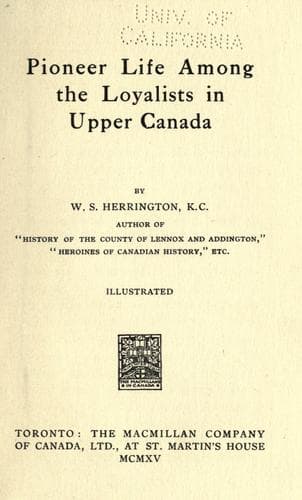
Pioneer Life among the Loyalists in Upper CanadaHerrington, Walter Stevens
History
Pioneer Life among the Loyalists in Upper Canada
Herrington, Walter Stevens
Frontier and pioneer life -- Ontario
The Methodists looked upon dancing not only as a very worldly but also
as a very sinful form of amusement, and as the violin was closely
associated with the dance it also was placed under the ban. The
Loyalists were musically inclined, but during the first years of the
settlements little opportunity was offered for the development of their
talents in that direction. Later on singing in unison was extensively
practised, and singing schools were organized during the winter months
in nearly every neighbourhood. There was a great scarcity of musical
instruments before the introduction of the accordeon and concertina,
both of which were invented in 1829.
The members of the Society of Friends, or Quakers, as they were more
commonly called, were sorely handicapped by reason of their refusal to
take an oath under any circumstances. By their strict adherence to this
article in their creed they were debarred from holding any public
office, or giving evidence in any court of law. That this was a great
hardship, from which no relief could be obtained except by legislative
enactment, goes without saying. One of their number was regularly
elected to the first Parliament and trudged through the forest to the
seat of government at the assembling of the members. From purely
conscientious scruples he refused to take the prescribed oath, so his
seat was declared vacant, and he trudged back home again.
It is not to the credit of the other denominations of Christians, that
no steps were taken to relieve the Quakers from the disability under
which they were placed, until after twenty-five years of patient
endurance. It is true the disability was self-imposed; but they were
actuated by the purest of motives, and their exemplary lives and
standing in the community entitled them to more consideration from their
fellow citizens. The relief first extended to them, after the lapse of
a quarter of a century, was only partial, and allowed them to give
evidence in civil courts by a simple affirmation instead of an oath.
The Legislature having to that extent admitted the principle of
affirming instead of taking an oath, could find very little to justify
its course in postponing for another twenty years the admission of the
Quakers to their full rights, by accepting their affirmation in criminal
courts and in all other matters in which an oath was required.
Public-domain text, read in full here on John Shaqi.
Reviews
Reviews
No reviews yet
Be the first to share your thoughts on this work.
Join the Discussion
Join the discussion
Sign in to leave a comment or review.
Sign InorCreate an account