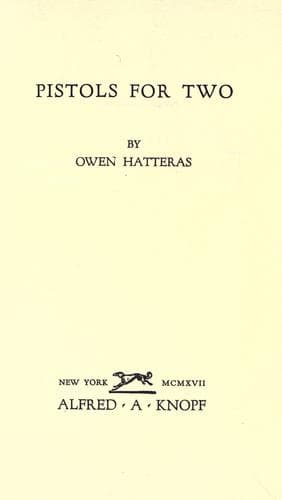
Authors, American -- 20th century -- Biography; Mencken, H. L. (Henry Louis), 1880-1956; Nathan, George Jean, 1882-1958
He is a third cousin of Signor Enrico Nathan, the late Socialist mayor
of Rome. His uncle, Dr. Émile Nathan van der Linde, _privat docent_ in
anthropology at Leyden, was killed by savages in Borneo in 1889, while
a member of the Oesterling exploring expedition.
He has never visited the battlefield at Gettysburg.
H. L. MENCKEN
He was born at Baltimore on Sunday, September 12, 1880, and was
baptized in the Church of England.
He was educated at the Baltimore Polytechnic, and is theoretically
competent to run a steam engine or a dynamo, but actually is quite
incapable of doing either.
Down to the age of fifteen it was his ambition to be a chemist, and
to this day he is full of fantastic chemical information and fond of
unloading it. At the age of fourteen he invented a means of toning
photographic silver prints with platinum.
The family business was tobacco, and he was drafted for it on leaving
school. He became a journeyman cigar-maker, and can make excellent
cigars to this day. But when chemistry and business died out,
literature set in, and he took to journalism.
At the age of twenty-three he was city editor and at twenty-five
managing editor of the Baltimore _Herald_, now defunct—the youngest
managing editor of a big city daily in the United States.
He printed a book of poems at twenty-two—now a rare _bibelot_. He was
“discovered,” as the saying is, by Ellery Sedgwick, now editor of
the _Atlantic Monthly_, but then running _Leslie’s Monthly_. He and
Sedgwick have remained on friendly terms to this day, but he sometimes
writes for the _Atlantic_.
In 1900, having read Lafcadio Hearn’s “Two Years in the French West
Indies,” he shipped on a banana boat for the Spanish Main, and has
returned to the West Indies three times since.
He is five feet, eight and a half inches in height, and weighs about
185 pounds. In 1915 he bulged up to 197 pounds. Then he took the Vance
Thompson cure and reduced to 175, rebounding later.
The things he dislikes most are Methodists, college professors,
newspaper editorials (of which, in his time, he has written more than
10,000), Broadway restaurants, reformers, actors, children, magazine
fiction, dining out, the New Freedom, prohibition, sex hygiene, _The
Nation_, soft drinks, women under thirty, the nonconformist conscience,
Socialism, good business men, the moral theory of the world, and the
sort of patriotism that makes a noise.
Among the men he admires are Joseph Conrad, W. R. Hearst, E. W. Howe,
Richard Strauss, Anatole France, and Erich Ludendorff—this last because
he is a great general and has never uttered a single word of patriotic
or pietistic cant. He likes Dreiser, but does not admire him.
His taste in female beauty runs to a slim hussy, not too young, with
dark eyes and a relish for wit. He abhors sentimentality in women,
holding that it is a masculine weakness, and unbecoming the fair. He
seldom falls in love, and then only momentarily.
Public-domain text, read in full here on John Shaqi.
Reviews
Reviews
No reviews yet
Be the first to share your thoughts on this work.
Join the Discussion
Join the discussion
Sign in to leave a comment or review.
Sign InorCreate an account