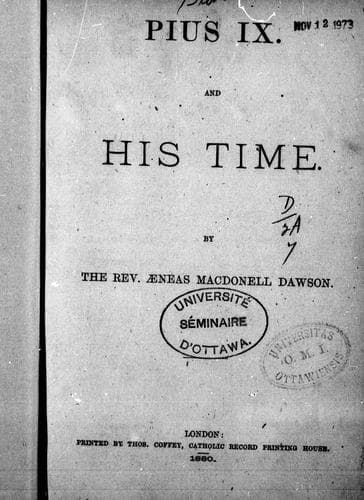
Pius IX.
And His Time
By
The Rev. Æneas MacDonell Dawson.
London:
Printed by Thos. Coffey, Catholic Record Printing House.
1880
CONTENTS
Preface.
Pius IX. And His Time.
Footnotes
PREFACE.
The history of Pius IX. will always be read with interest. His Pontificate
was, indeed, eventful. In no preceding age were the annals of the Church
so grandly illustrated.
The spiritual sovereignty, “with which,” to use the words of a British
statesman, “there is nothing on this earth that can at all compare,” was
crowned with surpassing glory. Doctrines which, hitherto, had been open to
theological discussion, were ascertained and pronounced to be in
accordance with the belief of all preceding Christian ages. The Church was
enabled, through the labors of her Chief and the zeal of her Priesthood,
to extend vastly the place of her tent. The life of Pius IX. himself was a
marvel and a glory. None of his predecessors, not even Peter, attained to
his length of days.
On the other hand, the venerable Pontiff, and, together with him, the
Catholic people, were doomed to behold and lament the loss of the
time-honored patrimony of St. Peter. The Papacy, however, unlike all
temporal sovereignties, was able to sustain so great a loss. More ancient
than its temporal power, it still survives; “not a mere antique, but in
undiminished vigor.”
PIUS IX. AND HIS TIME.
John Mary Count Mastai Ferreti was born at Sinigaglia, on the 13th of May,
1792. At the age of twenty-two he came to Rome. Anxious to serve the Holy
Father, and yet not aspiring to the priesthood, he resolved to become a
member of the Noble Guard. This the delicate state of his health forbade.
Repelled by the Prince Commandant, he sought counsel of the Pope. Pius
VII. pronounced that his destiny was the Cross, and advised him to devote
himself to the ecclesiastical state. The words of the Holy Father were, to
the youthful Mastai, as a voice from on high. He decided for the Church,
and, as if in testimony that his decision was ratified in heaven, the
falling-sickness left him. His studies were more than ordinarily
successful, and he already gave proof of those high qualities which were
afterwards so greatly developed. The distinguished Canon Graniare, his
professor, little dreaming of the exalted destiny which awaited him, held
him up as a pattern of excellence to his fellow-students, saying that he
possessed the heart of a Pope.
Public-domain text, read in full here on John Shaqi.
Reviews
Reviews
No reviews yet
Be the first to share your thoughts on this work.
Join the Discussion
Join the discussion
Sign in to leave a comment or review.
Sign InorCreate an account