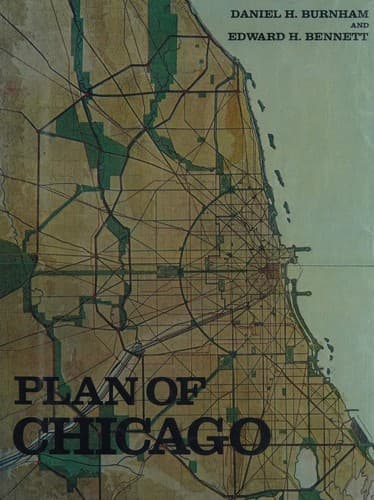
City planning -- Illinois -- Chicago -- History -- 20th century
The selection of Congress Street for development into a broad cross
avenue is urged by many considerations. First, this particular street
coincides substantially with the center of the business district;
and also is about equidistant from the other east-and-west streets
(Twelfth and Washington, and Twenty-second and Chicago Avenue) which
most readily lend themselves to development as arteries in the street
system; and it is also equidistant from the two great east-and-west
railroad rights-of-way at Kinzie and at Sixteenth streets. Secondly,
the very fact that Congress Street now exists only in disconnected
portions, and that the buildings throughout the proposed cutting are
comparatively inexpensive, offers a very strong argument for its
selection on the score of economy. The widening of another street would
mean the destruction of two frontages in order to obtain sufficient
width without encroaching on the building space on parallel streets.
Thirdly, Congress Street stands in such relations to Grant Park that
its use as a central axis of the city allows park and avenue to
sustain reciprocal relations in the highest degree conducive both to
convenience and to good order. Fourthly, the opening of Congress Street
would create, in combination with Van Buren Street on the north and
Harrison Street on the south, a triple set of arteries at the center of
things. There are no arguments favoring the selection of another street
which present such a combination of advantages as is to be found in
the choice of Congress Street. The diagram showing business occupancy
indicates that Congress Street is already very near the center of the
great commercial activities, and also that this center has steadily
moved in a southwesterly direction.
[Illustration: CXXXV. VIENNA. THE RINGSTRASSE, SHOWING THE PUBLIC
BUILDINGS GROUPED ABOUT SQUARES AND GARDENS ALONG ITS COURSE.]
Thus far the argument for the selection of Congress Street has dealt
with purely practical questions, which in themselves would seem to be
conclusive. The choice of Congress Street is quite as logical from an
æsthetic point of view. In a sense the Field Museum will be one of the
important buildings in the city. The site selected is exactly opposite
the intersection of Congress Street with Michigan Avenue. To create
a great cross avenue without utilizing the element of symmetry which
this noble building stands ready to furnish would be to set at defiance
every law of civic order, and to perpetrate a crime against good taste
that could never be atoned for. It is inconceivable that in the present
state of public taste any people would permit such a barbarism.
[Illustration: CXXXVI. ROME. ST. PETER’S CATHEDRAL, SHOWING THE
APPROACH.]
[Illustration: CXXXVII. CHICAGO. VIEW OF THE PROPOSED DEVELOPMENT IN
THE CENTER OF THE CITY, FROM TWENTY SECOND STREET TO CHICAGO AVENUE,
LOOKING TOWARDS THE EAST OVER THE CIVIC CENTER TO GRANT PARK AND LAKE
MICHIGAN.
Public-domain text, read in full here on John Shaqi.
Reviews
Reviews
No reviews yet
Be the first to share your thoughts on this work.
Elsewhere in the archive
Join the Discussion
Join the discussion
Sign in to leave a comment or review.
Sign InorCreate an account