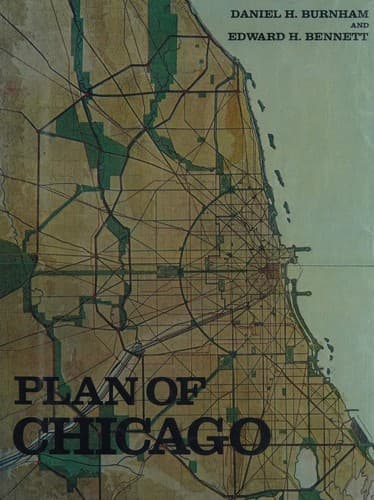
City planning -- Illinois -- Chicago -- History -- 20th century
Even such a law, however, would fall short of the public need. To
give the city or other agency a free hand in controlling the environs
of a public place, the authorities should be invested with power to
acquire the actual title, and then to dispose of it subject to such
restrictions as might be deemed expedient. This course offers the
double advantage of giving the public agency absolute control of the
future use and improvement of the surrounding property, and of enabling
it, if the price of acquisition is not too great, to recoup in some
measure the cost of the improvement by selling the residual title. A
lot abutting on a park or boulevard might be worth much more after it
had become part of a larger area subject to uniform building lines and
restrictions than it was in its unencumbered condition; and the public
authorities, by treating the whole improvement and its environment as
a unit, might reap a pecuniary advantage which they could not have
conferred upon individual owners even if they had desired to do so.
An examination of the power of municipalities to take land in excess
of physical requirements involves two questions: first, whether extra
land can be taken merely for the purpose of selling it and defraying
the cost of the improvement; and, second, whether, even if that right
is denied, such land can be condemned and resold for the purpose of
imposing upon it building or sanitary restrictions and limitations of
use.
As already stated, it may be accepted as elementary that neither the
state, through its legislative department, nor any subordinate agency
of the state can take a man’s property against his will, under the
power of eminent domain, merely for the purpose of giving it or selling
it to another man. Such a taking would not be for public use and would
violate the state and federal constitutions. It by no means follows,
however, that a state agency, exercising the power of eminent domain,
is always forbidden to derive profit from the sale of property not
found to be actually needed. The activities of the Sanitary District
of Chicago suffice to show how an area larger than is demanded by the
ultimate needs of the public work may be acquired and converted into a
source of revenue. A municipal corporation enjoys a large discretion
in determining for itself how much land it needs for its public works,
and courts will not ordinarily curb its freedom of action unless the
exercise of the power of eminent domain is clearly excessive. If the
city council saw fit to condemn a strip of land five hundred feet
wide for an avenue or boulevard, the courts would have no right to
question its decision unless, in the particular instance, there was
some “manifest injustice, oppression or gross abuse of power”;[82]
nevertheless, if it did clearly appear as a fact that the ultimate
object was to lay out an avenue only one hundred feet in width, the
question would be squarely presented whether the margins on each
Public-domain text, read in full here on John Shaqi.
Reviews
Reviews
No reviews yet
Be the first to share your thoughts on this work.
Elsewhere in the archive
Join the Discussion
Join the discussion
Sign in to leave a comment or review.
Sign InorCreate an account