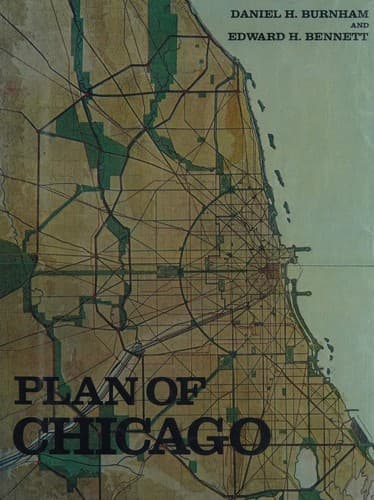
City planning -- Illinois -- Chicago -- History -- 20th century
In order to justify the appropriation of a zone outside of the actual
lines of the public space, it must appear that the property is to be
made, in some sort, a part of the improvement; and that fact does
appear when the control of the debatable zone is sought in order
to save the environment of the public place from disfigurement or
objectionable use. That end suffices to justify the condemnation
of some interest in the zone; and it is well established by the
authorities that when the public good requires the appropriation of
some interest, the legislature is sole judge of the particular nature
of the interest that shall be taken, and may, without being answerable
to any court, declare that the interest to be taken shall be a fee
simple absolute. A railway company does not require the title, or even
the exclusive use, of its entire right-of-way; yet it is not doubted
that, in the absence of a constitutional restriction, the legislature
might authorize a railway company to take the entire title. In most
states, the fee of a street remains in the owner of the property over
which the street is laid out under the power of eminent domain; yet
there is no question but that the legislature has power to vest the fee
in the city. The Supreme Court of Minnesota, in the case of _Fairchild_
v. _St. Paul_, 46 Minn. 540, where the question was raised whether the
city acquired through condemnation proceedings the actual title to the
street or only an easement, stated the established principles of the
law in the following language:
“There is nothing better settled than that, the power of eminent
domain being an incident of sovereignty, the time, manner and
occasion of its exercise are wholly in the control and discretion
of the legislature, except as restrained by the constitution. It
rests in the wisdom of the legislature to determine when and in what
manner the public necessities require its exercise; and with the
reasonableness of the exercise of that discretion the courts will
not interfere. As the legislature is the sole judge of the public
necessity which requires or renders expedient the exercise of the
power of eminent domain, so it is the exclusive judge of the amount
of land, and of the estate in land, which the public end to be
subserved requires to be taken. * * *
Public-domain text, read in full here on John Shaqi.
Reviews
Reviews
No reviews yet
Be the first to share your thoughts on this work.
Elsewhere in the archive
Join the Discussion
Join the discussion
Sign in to leave a comment or review.
Sign InorCreate an account