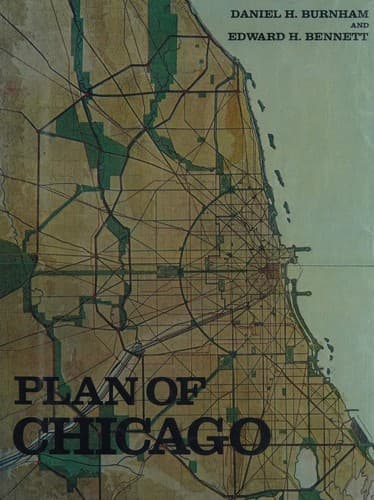
City planning -- Illinois -- Chicago -- History -- 20th century
“When the use is public, the necessity or expediency of appropriating
any particular property is not a subject of judicial cognizance.
Consequently, if in the legislative judgment it is expedient to do
so, it has the power expressly to authorize a municipal corporation
compulsorily to acquire the absolute fee simple to lands of private
persons condemned for street or any other public purpose. The
authorities are so numerous and uniform to this effect that an
extended citation of them is unnecessary. * * * It is often laid down
as the law that the taking of property must always be limited to the
necessity of the case, and, consequently, no more can be appropriated
in any instance than is needed for the particular use for which the
appropriation is made. But it will be found that this is almost
invariably said, not in discussing the extent of the power of the
legislature, but with reference to the construction of statutes
granting authority to exercise the right of eminent domain, and where
the authority to take a certain quantity of land or a particular
estate therein depended, not upon an express grant of power to do
so, but upon the existence of an alleged necessity, from which the
disputed power is to be implied.”
The city of Brooklyn acquired land for public parks under a statute
authorizing the acquisition of the title, and the court, in sustaining
the validity of a subsequent act of the legislature authorizing the
sale of portions of the land no longer needed, said:
“Doubtless, in most cases, when land is condemned for a special
purpose on the score of public utility, the sequestration is limited
to that particular use. But this is where the property is not taken,
but the use only. Then, the right of the public being limited to
the use, when the use ceases the right ceases. Where the property
is taken, the owner paid its true value, and the title vested in
the public, it owns the whole property, and not merely the use; and
though the particular use may be abandoned, the right to the property
remains.”[85]
Land acquired for canal purposes has often been held to have vested
absolutely in the state, so that upon abandonment of the canal the
premises could be devoted to a different use or sold to a private
purchaser.[86]
Some courts have intimated that land condemned for park purposes is
presumptively dedicated to that use forever; and, hence, that authority
to condemn for such a use implies authority to take the absolute
title. Moreover, if a statute provided that land acquired for a public
purpose could be sold when no longer needed, the implication would
seem to be unavoidable that the title acquired under the statute was
absolute. No general authority, however, has as yet been conferred upon
municipalities in this state to take under the power of eminent domain
a title that would survive the public use.
Public-domain text, read in full here on John Shaqi.
Reviews
Reviews
No reviews yet
Be the first to share your thoughts on this work.
Elsewhere in the archive
Join the Discussion
Join the discussion
Sign in to leave a comment or review.
Sign InorCreate an account