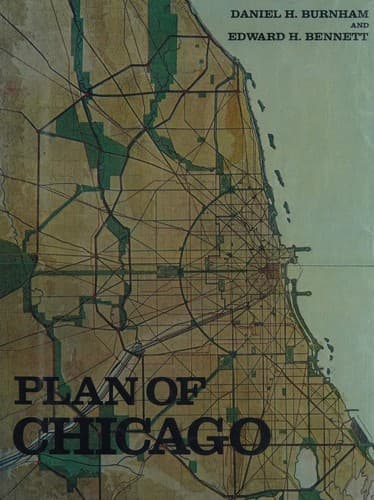
City planning -- Illinois -- Chicago -- History -- 20th century
This conception of the task is the justification of a comprehensive
plan of Chicago. To many who have given little consideration to the
subject, a plan seems to call for large expenditures and a consequent
increase in taxation. The reverse is the case. It is certain that
civic improvement will go on at an accelerated rate; and if those
improvements shall be marshaled according to a well-ordered plan great
saving must result. Good order and convenience are not expensive;
but haphazard and ill-considered projects invariably result in
extravagance and wastefulness. A plan insures that whenever any public
or semi-public work shall be undertaken, it will fall into its proper
and predetermined place in the general scheme, and thus contribute to
the unity and dignity of the city.
The plan frankly takes into consideration the fact that the American
city, and Chicago preeminently, is a center of industry and traffic.
Therefore attention is given to the betterment of commercial
facilities; to methods of transportation for persons and for goods;
to removing the obstacles which prevent or obstruct circulation;
and to the increase of convenience. It is realized, also, that good
workmanship requires a large degree of comfort on the part of the
workers in their homes and their surroundings, and ample opportunity
for that rest and recreation without which all work becomes drudgery.
Then, too, the city has a dignity to be maintained; and good order is
essential to material advancement. Consequently, the plan provides for
impressive groupings of public buildings, and reciprocal relations
among such groups. Moreover, consideration is given to the fact that
in all probability Chicago, within the lifetime of persons now living,
will become a greater city than any existing at the present time; and
that therefore the most comprehensive plans of to-day will need to be
supplemented in a not remote future. Opportunity for such expansion is
provided for.
The origin of the plan of Chicago can be traced directly to the World’s
Columbian Exposition. The World’s Fair of 1893 was the beginning, in
our day and in this country, of the orderly arrangement of extensive
public grounds and buildings. The result came about quite naturally.
Chicago had become a commercial community wherein men were accustomed
to get together to plan for the general good. Moreover, those at the
head of affairs were, many of them, the same individuals who had taken
part in every movement since the city had emerged from the condition of
a mere village. They were so accustomed to results even beyond their
most sanguine predictions, that it was easy for them to believe that
their Fair might surpass all fairs that had preceded it.
Public-domain text, read in full here on John Shaqi.
Reviews
Reviews
No reviews yet
Be the first to share your thoughts on this work.
Join the Discussion
Join the discussion
Sign in to leave a comment or review.
Sign InorCreate an account