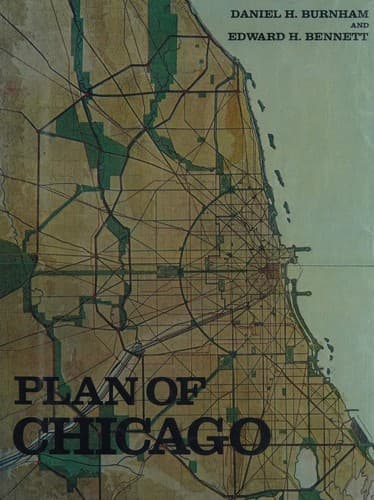
City planning -- Illinois -- Chicago -- History -- 20th century
The baths of Rome, both public and private, had accommodations for
62,800 citizens at a single time, and also every Roman house was
provided with bathing facilities. Beautiful porticoes enabled one to
cross under shelter the whole plain of the Campus Martius, a space
of between two and three miles; and similar structures connected all
the great buildings of the city, serving for markets and exchanges
and picture-galleries, and ministering to a thousand different wants.
Lovely gardens, with thickets of box, laurel, and myrtle, with lakes
and fountains, were enclosed by these porticoes, which were in
themselves architectural creations of rare marbles, the floors often
being inlaid with jasper and porphyry. The surrounding hills and the
valleys between, once the dumping-place of the city’s refuse, were
converted into magnificent gardens, forming stretches of verdure in
length sometimes exceeding two miles in a single composition.
To-day, after centuries of destruction and decay, Rome is taking on new
life. Her population is fast increasing; since 1870 scores of millions
of dollars have been spent on works of public utility and general
improvement; great thoroughfares have been created, the monuments
of the past have been opened to the light and air, the pestilential
conditions that during the centuries of her decadence hung over the
city like a pall have been removed by wise sanitation; the great
estates of noble families have been given over to the public; and again
the compelling power of Rome is being felt throughout the civilized
world.
During the slow centuries which followed upon the destruction and
decay of ancient civilization, no great works of civic utility or
adornment were undertaken, and the old were no longer maintained. As
the consciousness of national life again began to assert itself in
Europe, and the unifying forces of Christianity and Roman law began to
bind humanity together, the cities of Italy, of Germany, of France, and
of England grew strong and rich by industry and traffic; and throughout
western Europe the sense of permanence and power found expression in
the rearing and beautification of cities. Everywhere the same spirit
actuated the people, although in each land the mode of expression took
on characteristic form; and since the vital principle was religion, the
cathedral became the embodiment of the highest expression in civic art.
Public-domain text, read in full here on John Shaqi.
Reviews
Reviews
No reviews yet
Be the first to share your thoughts on this work.
Join the Discussion
Join the discussion
Sign in to leave a comment or review.
Sign InorCreate an account