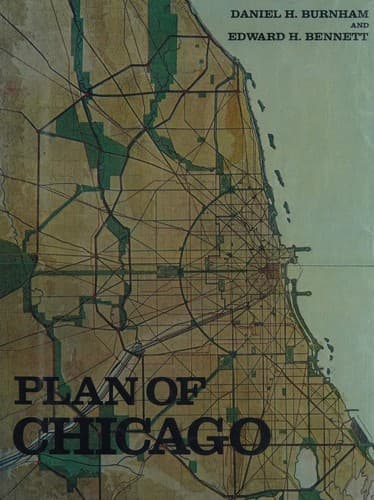
City planning -- Illinois -- Chicago -- History -- 20th century
No city in the world, says Charles Eliot Norton, appeals more strongly
to the poetic imagination than Venice. Rising in the dawn of modern
Europe, she linked the tradition of the old civilization to the fresh
conditions of the new. The destiny that ruled her beginnings seemed, as
she grew, to have had no element of chance, but to have been determined
by foresight and wise counsel. Her statesmen were the ablest, her
merchants the most adventurous and most successful, her seamen the
boldest, her craftsmen the most skillful, of their time. The affection
in which she was held by her people had the depth and intensity of a
passion.[3] As it was with Venice, so in a scarcely less degree it
fared with Florence and Siena, and other independent cities of Italy,
which vied with one another not only in power, but much more in beauty
and in the love borne them by their citizens. And to-day their charm
makes them the resort of people of taste and refinement, long after
their power has waned and only their beauty remains.
[Illustration: 1780.]
[Illustration: 1830.]
[Illustration: 1880.
XV. TRANSFORMATION OF THE BANKS OF THE SEINE IN PARIS.
Chronological views of the Petit Pont and Petit Chatelet, showing the
evolution of the boulevards.]
City planning, in the sense of regarding the city as an organic whole
and of developing its various units with reference to their relations
one to another, had its origin in Paris during the Bourbon period.
Among great cities, Paris has reached the highest stage of development;
and the method of this attainment affords lessons for all other
cities. Paris owes its origin and its growth to the convenience of its
location in view of increasing commercial conditions. Its beginnings
go back to the century before the Christian era, when it was but a
straggling village called Lutetia, occupying one of the islands in
the Seine. On the vast level plain adjoining the town, houses could
be erected indefinitely, while the numerous watercourses extending
into the surrounding regions gave easy access to the trader. Fertile
lands furnished an abundance of provisions; and brick-clay, lime, and
sand, with timber from the neighboring forests, provided materials for
building. The surroundings of Paris, so rich in all the requisites for
the creation of a great city, are similar to those of London and Berlin
and Chicago; and in each instance there is the same breadth in the
landscape.
Public-domain text, read in full here on John Shaqi.
Reviews
Reviews
No reviews yet
Be the first to share your thoughts on this work.
Join the Discussion
Join the discussion
Sign in to leave a comment or review.
Sign InorCreate an account