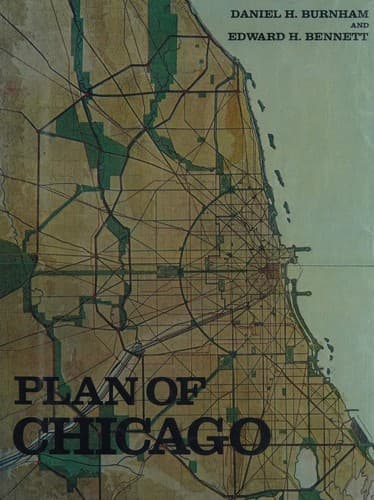
City planning -- Illinois -- Chicago -- History -- 20th century
Boston has developed the most extensive park system in America, at
a cost of $33,000,000, and is creating on the Charles River a tidal
basin which bids fair to rival any similar work in Europe. A state
commission is now studying means to relieve congestion in the city,
and to extend its commercial facilities. New York is struggling with
many isolated works of improvement spread over the broad domain of
that city’s activities; Baltimore is seeking to use the opportunity
presented by a great fire to introduce order and symmetry in her street
system, and also to create a connected park system; and the citizens
of St. Louis have prepared and presented a city plan for the grouping
of municipal buildings, for an inner and an outer park system, for
civic centers comprising small parks and playgrounds, museums, branch
libraries, and like public buildings.[13] San Francisco, even before
the great earthquake and fire of April, 1906, was already working on a
comprehensive plan to promote, in every practical way, the beautifying
of the streets, parks, squares, and public places of the city; to
bring to the attention of public officials and the citizens the best
methods of instituting artistic municipal betterments; to stimulate
the sentiment of civic pride in the improvement and care of private
property; and, in short, to make San Francisco a more agreeable city in
which to live. This latter movement resulted in a comprehensive city
plan which has been adopted by the general committee of citizens and by
the Board of Supervisors.[14]
[Illustration: XXXII. PLAN FOR A SUMMER CAPITAL OF THE PHILIPPINE
ISLANDS, AT BAGUIO.
Submitted to the Philippine Commission by D. H. Burnham, 1905.]
Philadelphia is cutting a great parkway from Logan Square to Fairmount
Park, with the expectation of extending the thoroughfare to the City
Hall; is acquiring extensive additions to its large parks; and is
planning for the grouping of its present buildings. Minneapolis and
St. Paul have made common cause in the creation of parkways, and the
last-named city is bent on securing adequate approaches for the newly
completed state capitol.[15] From Providence and Hartford in the East,
to Kansas City and on to Seattle in the West, the city planning is in
full progress. The South also has felt the new impulse. Annapolis, the
capital of Maryland, was laid out on lines strikingly similar to those
embodied in Sir Christopher Wren’s scheme for London; and the plan of
Williamsburg, the colonial capital of Virginia, suggests the locations
adopted for the Capitol and White House at Washington; so that the new
plans for Roanoke, Virginia, seem like the discovery of a lost art.
Public-domain text, read in full here on John Shaqi.
Reviews
Reviews
No reviews yet
Be the first to share your thoughts on this work.
Join the Discussion
Join the discussion
Sign in to leave a comment or review.
Sign InorCreate an account