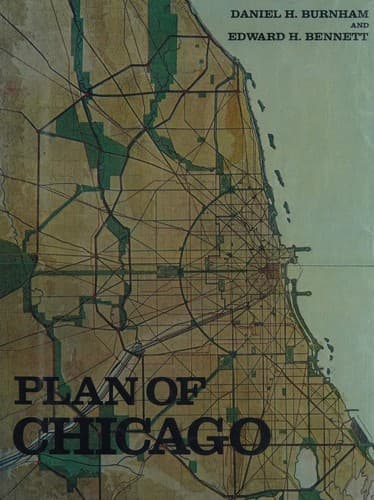
City planning -- Illinois -- Chicago -- History -- 20th century
CHICAGO THE METROPOLIS OF THE MIDDLE WEST: REASONS FOR EXPECTING
CONTINUOUS GROWTH: THE SUBURBS: A LAKESIDE DRIVEWAY ALONG LAKE
MICHIGAN: CONNECTIONS BETWEEN OUTLYING CITIES: THE BUILDING OF GOOD
ROADS
[Illustration: COTTONWOOD, NEAR CHICAGO.
Height, 127 ft.; diameter, 10 ft.]
Chicago is the metropolis of the Middle West, a term popularly applied
to the area known a century ago as the Territory Northwest of the
Ohio River. No section of the country, except New England, has so
distinct a history. Conquered by Virginia troops at the very time when
the Colonies were wresting their independence from Great Britain,
and held for the United States by the sagacity of Franklin and the
pertinacity of John Jay when the treaty of 1783 was negotiated, the Old
Northwest was the first territorial acquisition of the new republic.
Then, while the British still held the posts and only Indians and
fur-traders roamed its forests, the Congress of the Confederation
gave to the Northwest Territory in the Ordinance of 1787 a charter
which contained two provisions that during the years of development
exercised a unifying force comparable only to that brought about by
the extension of Christianity and the civil law during the Middle
Ages,—the prohibition of slavery, and the encouragement of free popular
education. The continuous struggle to preserve human freedom against
all the forces determined to extend slavery to the fertile fields of
the new West, and the establishment of schools and colleges supported
from a public treasury, brought about common aims and aspirations.
When the nation engaged in the struggle for its very life, this region
furnished the battle-ground for the statesmen; and when war came,
both the leader of the people and the commander in the field were the
embodiment of the spirit of the Middle West.
The domain over which Chicago holds primacy is larger than
Austria-Hungary, or Germany, or France; three thousand miles of
navigable waters form a portion of its boundaries; the rivers flowing
into the Great Lakes, the Mississippi, and the Ohio, give access to
every part of the interior; the level prairies invite the railroad and
the canal builder; the large proportion of arable land makes possible
the support of an enormous population; and the abundance and range of
the products of earth and forest furnish the materials for traffic.
It is no wonder, therefore, that the growth of the Middle West in
population and in wealth has been phenomenal; and that at the point of
convenience a city of the first order has sprung up.
Public-domain text, read in full here on John Shaqi.
Reviews
Reviews
No reviews yet
Be the first to share your thoughts on this work.
Join the Discussion
Join the discussion
Sign in to leave a comment or review.
Sign InorCreate an account