Plantation life; Virginia -- Social life and customs
Note: Images of the original pages are available through
Internet Archive. See
https://archive.org/details/plantationremini00burw
Transcriber's note:
Text enclosed by underscores is in italics (_italics_).
The author's name on the cover and in the copyright notice
seems to be a pseudonym. According to the catalog of the
Library of Congress, the author was Letitia M. Burwell.
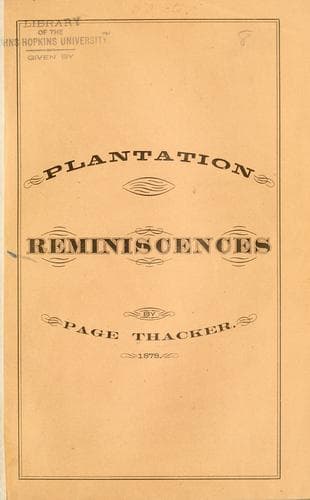
PLANTATION REMINISCENCES
by
PAGE THACKER.
1878.
Copyrighted in 1878 by Page Thacker.
DEDICATION.
Dedicated to my nieces, who will find in English and American
publications such epithets applied to their ancestors as: "Cruel
slave-owners;" "inhuman;" "Southern task masters;" "hard-hearted;"
"dealers in human souls," &c. From these they will naturally recoil
with horror. My own life would have been embittered had I believed
myself descended from such; and that those who come after us may know
the truth I wish to leave a record of plantation life as it was. The
truth may thus be preserved among a few, and the praise they deserve
awarded noble men and virtuous women who have passed away.
PREFACE.
For several years I have felt a desire to write these reminiscences,
but did not conclude to do so until receiving, a few months ago,
a letter from Mr. Martin F. Tupper--the English poet--in which he
wrote: "Let me encourage you in the idea of writing 'Plantation
Reminiscences.' It will be a good work; and it is time the world was
learning the truth. I myself have learned it and shall not be slow in
telling it to others."
PLANTATION REMINISCENCES.
CHAPTER I.
That my birth place should have been a Virginia plantation; my lot in
life cast on a Virginia plantation; my ancestors, for nine generations,
owners of Virginia plantations, remain facts mysterious and inexplicable
but to Him who determined the bounds of our habitations, and said: "Be
still, and know that I am God."
Confined exclusively to a Virginia plantation, during my earliest
childhood, I believed the world one vast plantation bounded by negro
quarters. Rows of white cabins with gardens attached; negro men in the
fields; negro women sewing, knitting, spinning, weaving, house-keeping
in the cabins, with negro children dancing, romping, singing, jumping,
playing around the doors, formed the only pictures familiar to my
childhood.
The master's residence--as the negroes called it, the "great
house"--occupied a central position, and was handsome and attractive;
the overseer's being a plainer house, about a mile from this.
Each cabin had as much pine furniture as the occupants desired; pine
and oak being abundant, and carpenters always at work for the comfort
of the plantation.
Bread, meat, milk, vegetables, fruit and fuel were as plentiful as
water in the springs near the cabin doors.
Public-domain text, read in full here on John Shaqi.
Reviews
Reviews
No reviews yet
Be the first to share your thoughts on this work.
Join the Discussion
Join the discussion
Sign in to leave a comment or review.
Sign InorCreate an account