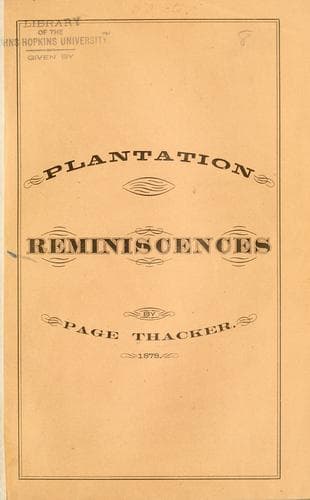
Plantation life; Virginia -- Social life and customs
I once attended a gay party where the young lady of the house--the
center of attraction--hearing that one of the negroes was suddenly very
ill, excused herself from the company, carried her Prayer-book to the
cabin, and passed the night by the bedside of the sick man, reading
and repeating verses to him. I have also had young lady friends who
declined attending a wedding or party when a favorite servant was ill.
On one occasion an English gentleman--Surgeon in the Royal
Artillery--visiting at our house, accompanied us to a wedding and
hearing that two young ladies had not attended on account of the
illness of a negro servant, said to me: "This would not have been in
England, and will scarcely be believed when I tell it on my return."
The same gentleman expressed astonishment at one of our neighbor's
sitting up all night to nurse one of his negroes who was ill. He was
amused at the manner of our servants' identifying themselves with the
master and his possessions, always speaking of "our horses," "our
cows," "our crop," "our mill," "our blacksmith's shop," "our carriage,"
"our black folks," &c. He told us he observed also a difference between
our menials and those of his own country, in that, while here they
were individualized, there they were known by the names of "Boots,"
"'Ostler," "Driver," "Footman," "Cook," "Waiter," "Scullion," &c.
On our plantations the most insignificant stable boy felt himself of
some importance.
When I heard Mr. Dickens read scenes from Nicholas Nickleby, the tone
of voice in which he personated Smike sent a chill through me, for I
had never before heard the human voice express such hopeless despair.
Can there be in England, thought I, human beings afraid of the sound of
their own voices?
There was a class of men in our State who made a business of buying
negroes to sell again farther south. These we never met, and held in
horror. But even they, when we reflect, could not have treated them
with inhumanity; for what man would pay a thousand dollars for a
piece of property, and fail to take the best possible care of it? The
"traders" usually bought their negroes when an estate became involved,
for the owners could not be induced to part with their negroes until
the last extremity--when everything else had been seized by their
creditors. Houses, lands, everything went first, before giving up the
negroes; the owner preferring to impoverish himself in the effort to
keep and provide for these--which was unwise, financially, and would
not have been thought of by a mercenary people.
Public-domain text, read in full here on John Shaqi.
Reviews
Reviews
No reviews yet
Be the first to share your thoughts on this work.
Join the Discussion
Join the discussion
Sign in to leave a comment or review.
Sign InorCreate an account