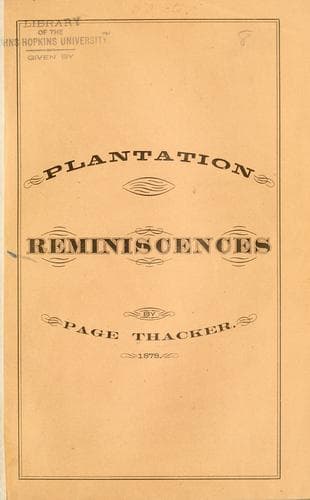
Plantation life; Virginia -- Social life and customs
But it was hard to part with one's "own people," and see them
scattered. Still our debts had to be paid; often security debts after
the death of the owner, when all had to be sold. And who of us but can
remember the tears of anguish caused by this, and scenes of sorrow to
which we can never revert without the keenest grief? Yet, like all
events in this chequered human life, even these sometimes turned out
best for the negroes, when by this means they exchanged unpleasant for
more agreeable homes. Still it appeared to me a great evil, and often
did I pray that God would make us a way of escape from it. But His ways
are past finding out, and why He had been pleased to order it thus we
shall never know.
Instances of harsh or cruel treatment were rare. I never heard of
more than two or three individuals who were "hard" or unkind to their
negroes, and these were ostracised from respectable society, their very
names bringing reproach and blight upon their descendants.
We knew of but one instance of cruelty on our plantation, and that was
when "Uncle Joe," the blacksmith, burnt his nephew's face with a hot
iron. The man carries the scar to this day, and in speaking of it,
always says: "Soon as my master found out how Uncle Joe treated me he
wouldn't let me work no more in his shop."
CHAPTER IV.
The extent of these estates precluding the possibility of near
neighbors, their isolation would have been intolerable but for the
custom of visiting which prevailed among us. Many houses were filled
with visitors the greater part of the year, usually remaining two or
three weeks. Visiting tours were made in our private carriages--each
family making at least one such tour a year. Nor was it necessary to
announce these visits by message or letter, each house being considered
always ready, and "entertaining company" the occupation of the people.
Sometimes two or three carriages might be descried in the evening
coming up to the door through the Lombardy poplar avenue--the usual
approach to many old houses--whereupon ensued a lively flutter among
small servants, who speedily got them into their clean aprons, and
ran to open gates, and remove parcels from carriages, and becoming
generally excited. Lady visitors were always accompanied by colored
maids, although sure of finding a superfluity of these at each
establishment. The mistress of the house always received her guests in
the front porch, with a sincere and cordial greeting.
Public-domain text, read in full here on John Shaqi.
Reviews
Reviews
No reviews yet
Be the first to share your thoughts on this work.
Join the Discussion
Join the discussion
Sign in to leave a comment or review.
Sign InorCreate an account