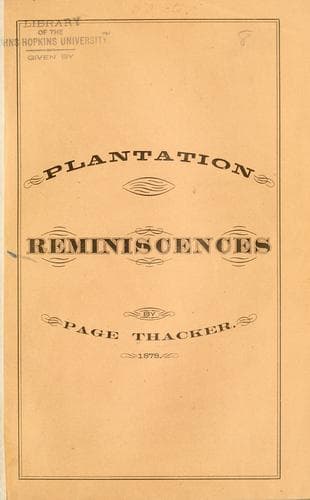
Plantation life; Virginia -- Social life and customs
Then there were old gentlemen visitors--beaux of my grandmother's
day--still wearing cues, wide ruffled bosoms, short pants and knee
buckles. These pronounced the _a_ very broad; sat a long time over
their wine at dinner, and carried in their pockets gold or silver
snuff-boxes presented by some distinguished individual at some remote
period.
Our visiting acquaintance extended from Botetourt county to Richmond,
and among them were jolly old Virginia gentlemen and precise
old Virginia gentlemen; eccentric old Virginia gentlemen and
prosy old Virginia gentlemen; courtly old Virginia gentlemen and
plain-mannered old Virginia gentlemen; charming old Virginia gentlemen
and uninteresting old Virginia gentlemen. Many of them had graduated
years and years ago at William and Mary College.
Then we had another set, of a later day--those who graduated in the
first graduating class at the University of Virginia, when that
institution was first established. These happened--all that we knew--to
have belonged to the same class, and often amused us--without intending
it--by reverting to that fact in these words:
"_That_ was a remarkable class! Every man in that class made his mark
in law, letters or politics! Let me see: There was Toombs. There was
Charles Mosby. There was Alexander Stuart. There was Burwell. There
was R. M. T. Hunter;" and so on, calling each by name except himself,
knowing that the others never failed to do that!
Edgar Poe and Alexander Stephens, of Georgia, were also at the
University with these gentlemen.
Although presenting an infinite variety of mind, manner and temperament,
all the gentlemen who visited us, young and old, possessed in
common certain characteristics; one of which was a deference to
ladies, which made us feel that we had been put in the world especially
to be waited upon by them. Their standard for woman was high. They
seemed to regard her as some rare and costly statue set in a niche to
be admired and _never taken_ down.
Another peculiarity they had in common, was a habit--which seemed
irresistible--of tracing people back to the remotest generation, and
appearing inconsolable if ever they failed to find out the pedigree of
any given individual for at least four generations. This, however, was
an innocent pastime, from which they seemed to derive much pleasure and
satisfaction, and which should not be regarded, even in this advanced
age, a serious fault.
Public-domain text, read in full here on John Shaqi.
Reviews
Reviews
No reviews yet
Be the first to share your thoughts on this work.
Join the Discussion
Join the discussion
Sign in to leave a comment or review.
Sign InorCreate an account