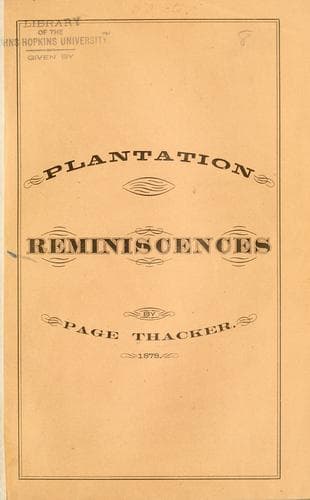
Plantation life; Virginia -- Social life and customs
Among our various visitors, was a kinsman--of whom I often heard,
but do not recollect--a bachelor of eighty years, always accompanied
by his negro servant as old as himself. Both had the same name,
Louis,--pronounced like the French--and this aged pair had been so
long together they could not exist apart. Black Louis rarely left his
master's side; assisting in the conversation if his master became
perplexed or forgetful. When his master talked in the parlor, black
Louis always planted his chair in the middle of the door-sill, every
now and then correcting or reminding with: "Now, master, dat warnt Col.
Taylor's horse dat won dat race dat day. You and me was thar." Or,
"Now, master you done forgot all 'bout dat. Dat was in de year 1779,
and _dis_ is de way it happened," &c., much to the amusement of the
company assembled. All this was said, I am told, most respectfully,
although the old negro in a manner _possessed_ his master, having
entire charge and command of him.
The negroes often felt great pride in "_their_ white people," as they
called their owners, and loved to brag about what "_their_ white
people" did and what "_their_ white people" had.
On one occasion it became necessary for my sister and myself to ride
a short distance in a public conveyance. A small colored boy, who
helped in our dining-room, had to get in the same stage. Two old
gentlemen--strangers to us--sitting opposite, supposing we had fallen
asleep, when we closed our eyes to keep out the dust, commenced talking
about us. Said one to the other: "Now those children will spoil their
Sunday bonnets." Whereupon our colored boy spoke up quickly: "Umph!
_you_ think _them's_ my mistesses' Sunday bonnets? Umph! you _jes
ought_ to see what they got up thar on top the stage in thar band
box!" At this we both laughed, for the boy had never seen our "Sunday
bonnets," nor did he know that we possessed any.
CHAPTER V.
English books never fail to make honorable mention of a "roast of
beef," "a leg of mutton," "a dish of potatoes," "a dish of tea," &c.,
while with us the abundance of such things gave them, we thought, not
enough importance to be particularized. Still my reminiscences extend
to these.
Every Virginia housewife knew how to compound all the various dishes
in Mrs. Randolph's Cookery book, and our tables were filled with every
species of meat and vegetable to be found on a plantation; with every
kind of cakes, jellies and blanc-mange to be concocted out of eggs,
butter and cream, besides an endless catalogue of preserves, sweet
meats, pickles and condiments. So that in the matter of good living,
both in abundance and the manner of serving, a Virginia plantation
could not be excelled.
Public-domain text, read in full here on John Shaqi.
Reviews
Reviews
No reviews yet
Be the first to share your thoughts on this work.
Join the Discussion
Join the discussion
Sign in to leave a comment or review.
Sign InorCreate an account