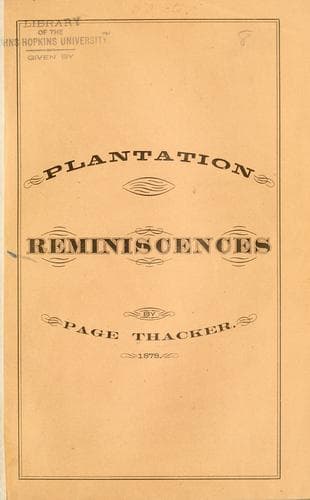
Plantation life; Virginia -- Social life and customs
If in Heaven there be one seat higher than another, it must be reserved
for those true Southern matrons, who performed conscientiously their
part assigned them by God--civilizing and instructing this race.
To the children of Israel God said: "I will give thee the heathen for
an inheritance." So He had given _us_ "the heathen for an inheritance,"
and however bitterly some of us deplored it--as we did--we should have
remembered that nothing happens by chance; but that God disposes all
events for some purpose of his own. We were instruments in His hand,
and if we or our forefathers were chosen by Him to elevate a race in
the scale of comfort and intelligence we should not deplore it, but
pray that what we have done for them may be a lasting benefit and that
God's blessing may follow them in another condition of life.
However we may differ in the opinion, there is no greater compliment to
Southern slave owners than the idea prevailing in many places that the
negro is already sufficiently elevated to hold the highest positions in
the gift of our Government.
I once met in traveling an English gentleman, who asked me: "How can
you bear those miserable black negroes about your houses and about your
persons? To me they are horribly repulsive, and I would not endure one
about me."
"Neither would they have been my choice," I replied. "But God sent them
to us. I was born to this inheritance and could not avert it. What
would _you_ English have done," I asked, "if God had sent them to you?"
"Thrown them into the bottom of the sea!" he replied.
Fortunately for the poor negro this sentiment had not prevailed among
us. I believe God endowed our people with qualities peculiarly adapted
to taking charge of this race and that no other nation could have kept
them. Our people did not demand as much work as in other countries is
required of servants; and I think had more affection for them than is
elsewhere felt for menials.
In this connection, I remember an incident during the war which
deserves to be recorded as showing the affection entertained for negro
dependents:
When our soldiers were nearly starved, and only allowed daily a
small handfull of parched corn, the Colonel of a Virginia regiment,
by accident got some coffee, a small portion of which was daily
distributed to each man. In the regiment was a cousin of mine--a young
man endowed with the noblest attributes God can give--who, although
famishing and needing it, denied himself his portion every day that
he might bring it to his black mammy. He made a small bag in which he
deposited and carefully saved it.
When he arrived at home on furlough, his mother wept to see his
tattered clothes, his shoeless feet and starved appearance.
Soon producing the little bag of coffee, with a cheerful smile he said:
"See what I've saved to bring black mammy!"
"Oh! my son," said his mother, "you have needed it yourself. Why did
you not use it?"
Public-domain text, read in full here on John Shaqi.
Reviews
Reviews
No reviews yet
Be the first to share your thoughts on this work.
Join the Discussion
Join the discussion
Sign in to leave a comment or review.
Sign InorCreate an account