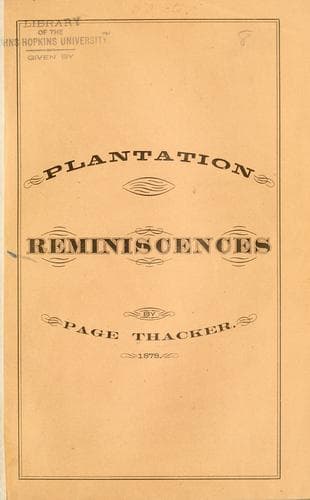
Plantation life; Virginia -- Social life and customs
"But," he replied, "I can't help talking, for I hear our people abused,
and called indolent and self-indulgent, when I know they have valor and
endurance enough. And I believe so much 'material progress' leaves no
leisure for the highest development of heart and mind. Where the whole
energy of a people is applied to making money, the souls of men become
dwarfed."
"We do not feel," we said, "like abusing Northern people, in whose
thrift and enterprise we found much to admire; and especially the
self-reliance of their women, enabling them to take care of themselves
and travel from Maine to the Gulf without an escort, while we find it
impossible to travel a day's journey without a special protector."
"That is just what I don't like," said he, "to see a woman in a crowd
of strangers needing no 'special protector.'"
"This dependence upon your sex," we replied, "keeps you so vain."
"We would lose our gallantry altogether," said he, "if we found you
could get along without us."
CHAPTER VII.
After some months--ceasing to think and speak of New York--our lives
glided back into the old channel, where the placid stream of life had
many isles of simple pleasures.
We were, in those days, not "whirled with glowing wheel over the
iron track in a crowded car," with dirty, shrieking children and
repulsive-looking people--on their way to the small pox hospital, for
all we knew. We were not jammed against rough, dreadful-looking people,
eating dreadful smelling things, out of dreadful-looking baskets and
satchels, and throwing the remains of dreadful pies and sausages over
the cushioned seats.
Oh, no! our journeys were performed in venerable carriages, and our
lunch was enjoyed by some cool, shady spring where we stopped in some
shady forest at midday.
Our own venerable carriage, my sister styled, "The old ship of Zion,"
saying, "It had carried many thousands, and was likely to carry many
more." And our driver we called the "Ancient Mariner." He presided on
his seat--a high perch--in a very high hat and with great dignity.
Having been driving the same carriage for nearly forty years--no driver
being thought safe who had not been on the carriage box at least twenty
years--considered himself an oracle, and in consequence of his years
and experience kept us in much awe--my sister and myself never daring
to ask him to quicken or retard his pace or change the direction of the
road, however much we desired it. We will ever remember this thraldom,
and how we often wished one of the younger negroes could be allowed to
take his place, but my grandmother said "it would wound his feelings,
and besides be very unsafe" for us.
Public-domain text, read in full here on John Shaqi.
Reviews
Reviews
No reviews yet
Be the first to share your thoughts on this work.
Join the Discussion
Join the discussion
Sign in to leave a comment or review.
Sign InorCreate an account