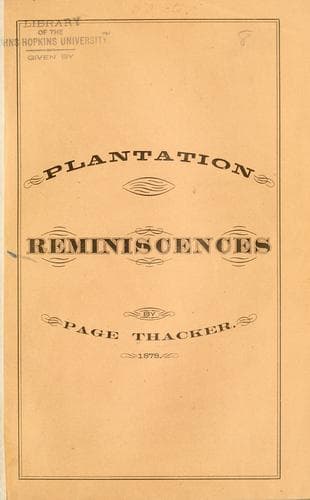
Plantation life; Virginia -- Social life and customs
In this little plantation world of ours was one being--and only
one--who inspired awe in every heart, being a special terror to small
children. This was the Queen of the Kitchen--Aunt Christian--who
reigned supreme. She wore the whitest cotton cap, with the broadest of
ruffles; was very black and very portly, and her sceptre was a good
sized stick, kept to chastise small dogs and children who invaded her
territory. Her character, however, having been long established she had
not often occasion to use this weapon, as these enemies kept out of her
way.
Her pride was great, for, said she: "Haven't I been, long before this
here little master whar is was born, bakin' the best light-bread and
waffles and biscuit; and in my old master's time managed my own affars!"
She was generally left to manage "her own affars," and being a pattern
of neatness and industry her fame went abroad from Botetourt, even unto
the remotest ends of Mecklenburg county.
That this marvellous cooking was all the work of her own hands I am,
in later years, inclined to doubt, as she kept several assistants, a
boy to chop wood, beat biscuit, scour tables, lift off pots and ovens;
one woman to make the pastry and another to compound cakes and jellies.
But her fame was great; her pride lofty, and I would not now pluck one
laurel from her wreath.
This honest woman was appreciated by my mother, but we had no affinity
for her, in consequence of certain traditions on the plantation about
her severity to children. Having no children of her own, a favorite
orphan house-girl, whenever my mother went from home, was left to her
care. This girl--now an elderly woman, and still our faithful and loved
servant,--says she remembers to this day her joy at my mother's return
home, and her release from Aunt Christian. "I will never forget," to
use her own words, "how I watched the road every day, hoping that
mistress would come back, and when I saw the carriage I would run a
mile, shouting and clapping my hands."
Smiling faces always welcomed us home as the carriage passed through
the plantation, and on reaching the house we were received by the
negroes about the yard with liveliest demonstrations of pleasure.
CHAPTER II.
It was a long time before it dawned upon my mind there were places
and people different from these. The plantations we visited seemed
exactly like ours. The same hospitality everywhere, the same kindliness
existing between the white family and the blacks.
Confined exclusively to plantation scenes, the most trifling incidents
impressed themselves indelibly upon me.
One day while my mother was in the yard attending to the planting of
some shrubbery, we saw approaching an old, feeble negro man, leaning
upon his stick. His clothes were nearly worn out, and he, haggard and
thin.
"Good day, Mistess," said he.
"Who are you?" asked my mother.
Public-domain text, read in full here on John Shaqi.
Reviews
Reviews
No reviews yet
Be the first to share your thoughts on this work.
Join the Discussion
Join the discussion
Sign in to leave a comment or review.
Sign InorCreate an account