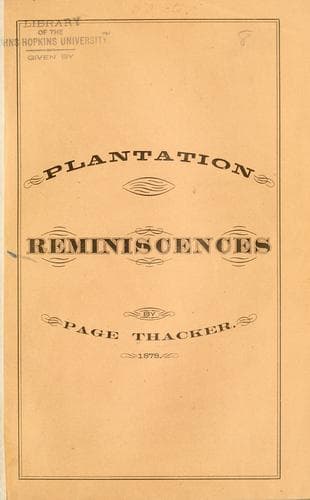
Plantation life; Virginia -- Social life and customs
"My name is John," he replied, "and I belonged to your husband's uncle.
He died a long time ago. Before he died he set me free and gave me
a good piece of land near Petersburg, and some money and stock. But
all--my money and land--all gone, and I was starving. So I come one
hundred miles to beg you and master please let me live and die on your
plantation. I don't want to be free no longer. Please don't let me be
free."
I wondered what was meant by being "free," and supposed from his
appearance it must be some very dreadful and unfortunate condition of
humanity. My mother heard him very kindly, and directed him to the
kitchen where "Aunt Christian" would give him a plenty to eat.
Although there were already a number of old negroes to be supported,
who no longer considered themselves young enough to work, this old man
was added to the number, and a cabin built for him. To the day of his
death he expressed gratitude to my mother for taking care of him, and
often entertained us with accounts of _his_ "old master's times," which
he said were the "grandest of all."
By way of apology for certain knotty excrescences on his feet, he
used to say: "You see these here knots. Well, they come from my being
a monstrous proud young nigger, and squeezin' my feet in de tightest
boots to drive my master's carriage 'bout Petersburg. I nuver was
so happy as when I was drivin' my coach-an'-four, and crackin' de
postillion over de head wid my whip."
These pleasant reminiscences were generally concluded with: "Ah! young
Misses, _you'll_ nuver see sich times. No more postillions! No more
coach-an'-four! And niggers drives _now_ widout they white gloves. Ah!
no, young Misses, _you'll_ nuver see nothin'! _Nuver_, in _your_ time."
With these melancholy predictions would he shake his head, and sigh
that the days of glory had departed.
Each generation of blacks vied with the other in extolling the virtues
of their particular mistress and master and "_their times_;" but
notwithstanding this mournful contrast between the past and present,
their reminiscences had a certain charm. Often by their cabin firesides
would we listen to the tales of the olden days about our forefathers,
of whom they could tell much, having belonged to our family since the
landing of the African fathers on the English slave ships, from which
their ancestors had been bought by ours. Among these traditions none
pleased us so much as that an unkind mistress or master had never been
known among our ancestors, which we have always considered a cause for
greater pride than the armorial bearings left on their tombstones.
We often listened with pleasure to the recollections of an old blind
man--the former faithful attendant of our grand-father--whose mind
was filled with vivid pictures of the past. He repeated verbatim
conversations and speeches heard sixty years before--from Mr. Madison,
Mr. Jefferson, Mr. Clay, and other statesmen, his master's special
friends.
Public-domain text, read in full here on John Shaqi.
Reviews
Reviews
No reviews yet
Be the first to share your thoughts on this work.
Join the Discussion
Join the discussion
Sign in to leave a comment or review.
Sign InorCreate an account